
Search Experience Optimization.
AI-Driven Organic Growth.
The way people search has changed more in the last two years than in the entire previous decade. Unlock sustainable organic growth by uniting search visibility, user experience, and conversion science into one future-proof strategy engineered for Google's AI Overviews and multimodal interfaces.
Request an SXO Audit
Share your domain details. Our strategists will analyze your AI Overview visibility, Core Web Vitals, and intent fulfillment gaps.
Search Engine Optimization Is Dead.
The Era of Experience Has Arrived.

Google's AI Overviews now dominate the top of the search engine results page. Voice, image, and text searches happen side by side in a fluid, multimodal ecosystem. Zero-click searches crossed sixty-five percent globally in mid-2025 and are rapidly approaching seventy percent as of June 2026. Brands that have stubbornly relied on traditional SEO tactics are watching their organic traffic dry up. They are seeing their hard-earned featured snippets get replaced by AI-generated answers, and they are watching their conversion paths completely fall apart.
However, not every brand is struggling in this new reality. Some corporations and agile challengers are quietly growing faster than ever before. They are achieving this hyper-growth because they made the fundamental shift to Search Experience Optimization (SXO), a comprehensive strategy that goes far beyond traditional keyword rankings to focus strictly on the complete user journey, tracking behavior from the exact moment someone types a query to the exact moment they convert.
What Is Search Experience Optimization?

Search Experience Optimization is the strategic, mathematical integration of three digital disciplines that have historically operated in complete isolation from one another. First, there is traditional Search Engine Optimization (SEO), which focuses entirely on earning visibility in the search engine results pages. Second, there is User Experience (UX) design, which aims to make every digital visit intuitive, fast, and psychologically satisfying. Third, there is Conversion Rate Optimization (CRO), the rigorous scientific process of turning passive visits into measurable, bottom-line business outcomes.
What makes SXO fundamentally different is not merely the combination of these three practices. It is the crucial recognition that modern Google algorithms now evaluate all three of these elements simultaneously. An informative page that ranks highly but frustrates users with a poor layout will rapidly fall in visibility. Conversely, a beautifully designed page that delights users but lacks semantic authority will never rank in the first place. SXO brings all these elements into perfect alignment so that every technical optimization serves both the search engine's crawling mechanisms and the human being behind the screen.
How Search Got Here: The Evolution That Made SXO Essential

To understand why SXO is the only viable path forward, we must look at the algorithmic history that brought us here. The conceptual roots of SXO go back to 2015 when Google introduced RankBrain. This was its first machine-learning algorithm built specifically to interpret ambiguous queries and measure genuine user satisfaction. For the first time in internet history, "dwell time" (how long someone stays on a page) and "pogo-sticking" (clicking back to the search results immediately) became powerful signals that directly affected rankings.
Marketers who had built their entire strategy around keyword density and domain authority hit a massive wall. Ranking in the first position meant absolutely nothing if users immediately bounced. A small group of forward-thinking practitioners coined the term "Search Experience Optimization" around 2016 to describe what this new era demanded. They realized that SEO, UX, and conversion needed to work from a single unified blueprint. Over the following years, Google vigorously reinforced this direction through a series of major algorithmic updates.
2019 to 2023: User Signals Become Ranking Signals

- 2019, The BERT Update: Natural language processing helped Google deeply understand context and nuance within sentences. Conversational, intent-matched content surged in rankings while robotic keyword-stuffed pages plummeted.
- 2021, The Page Experience Update: Core Web Vitals (including metrics like LCP, FID, and CLS) became official, undeniable ranking signals. Page speed and visual stability were now direct levers for organic visibility.
- 2023, The E-E-A-T Elevation: Google's quality guidelines formalized Experience, Expertise, Authoritativeness, and Trustworthiness as mandatory ranking considerations. This was especially critical for "Your Money or Your Life" (YMYL) topics encompassing health, finance, and major life decisions.
2024 to 2026: The AI Shift Changes Everything

- 2024, The Rise of AI Overviews: Google aggressively began synthesizing answers from multiple disparate sources directly at the top of the search results page. Traditional traffic models completely broke down as generative answers started resolving user queries before they ever clicked a traditional blue link.
- 2025, The Era of Multimodal Search: Technologies like Google Lens, voice queries, and integrated image-based searches became entirely mainstream. The definition of SXO expanded significantly to cover highly optimized visual and auditory content structures.
- March 2026 Core Update: Google refined exactly how it measures "Helpful Content" alongside local engagement signals. Sites featuring deep, interactive content gained massive market share, whereas thin informational affiliate pages dropped into obscurity overnight.
- June 2026 Core Update: Google shifted even further toward rewarding educational depth, verifiable community engagement, and crystal-clear content architecture. Google's own documentation now explicitly prioritizes "people-first content that comprehensively satisfies a complex journey."
At each of these historical milestones, the functional gap between SEO and UX narrowed considerably. By June 2026, they are effectively inseparable. SXO is no longer a fleeting industry trend. It is the singular, coherent strategy required for earning visibility, sustained engagement, and measurable revenue in today's highly complex search environment.
The Six Pillars of Modern SXO

Modern Search Experience Optimization is built on six entirely interdependent pillars. Neglecting any one of them creates a severe leak in your organic growth funnel. When all six work together seamlessly, they produce a compounding algorithmic effect that traditional SEO simply cannot replicate.
1. Intent-Driven Content Architecture

Keyword research in the traditional sense is no longer sufficient. True SXO starts with exhaustive intent mapping. This involves understanding the full cognitive journey behind every possible query cluster. A user searching for software is not merely looking for a list. They move through a complex sequence of needs from broad informational queries to highly specific transactional comparisons. Our architecture covers this entire arc through meticulously designed topic clusters, pillar pages, and supporting hubs that precisely mirror the user's mental model.
2. Technical Experience & Core Web Vitals

Technical SEO has completely moved beyond basic crawling and indexing. It is now evaluated based on the perceived performance at every single user interaction. Google's transition to Interaction to Next Paint (INP) as a dominant Core Web Vital shifted the focus heavily from mere loading speed to dynamic responsiveness. Our SXO framework treats Core Web Vitals as a continuous engineering discipline. We enforce strict LCP standards under 1.8 seconds and keep INP below 200 milliseconds to guarantee a frictionless digital experience.
3. User Engagement Satisfaction Signals

Google's AI networks are now highly effective at analyzing post-click user behavior. Elevated pogo-sticking rates act as a severe negative ranking signal. Conversely, long sessions that feature active scrolling, internal link clicks, and content interaction prove to Google that the page comprehensively satisfied the query. We weave engagement elements into your layout, including sticky navigation links, interactive diagnostic calculators, embedded multimedia, and answer-first summary sections that naturally compel the user to interact.
4. E-E-A-T & Trust Architecture

In a digital landscape where AI-generated content can instantly flood any topical niche, Google increasingly prioritizes demonstrable, verifiable human trust. For a page to rank exceptionally well and be cited directly in an AI Overview, it must convey real-world credibility. We engineer E-E-A-T deeply into your page design by integrating verified author biographies, transparent citations to peer-reviewed studies, prominently placed customer trust badges, and highly visible timestamps indicating rigorous editorial reviews.
5. Conversion-Centered Design
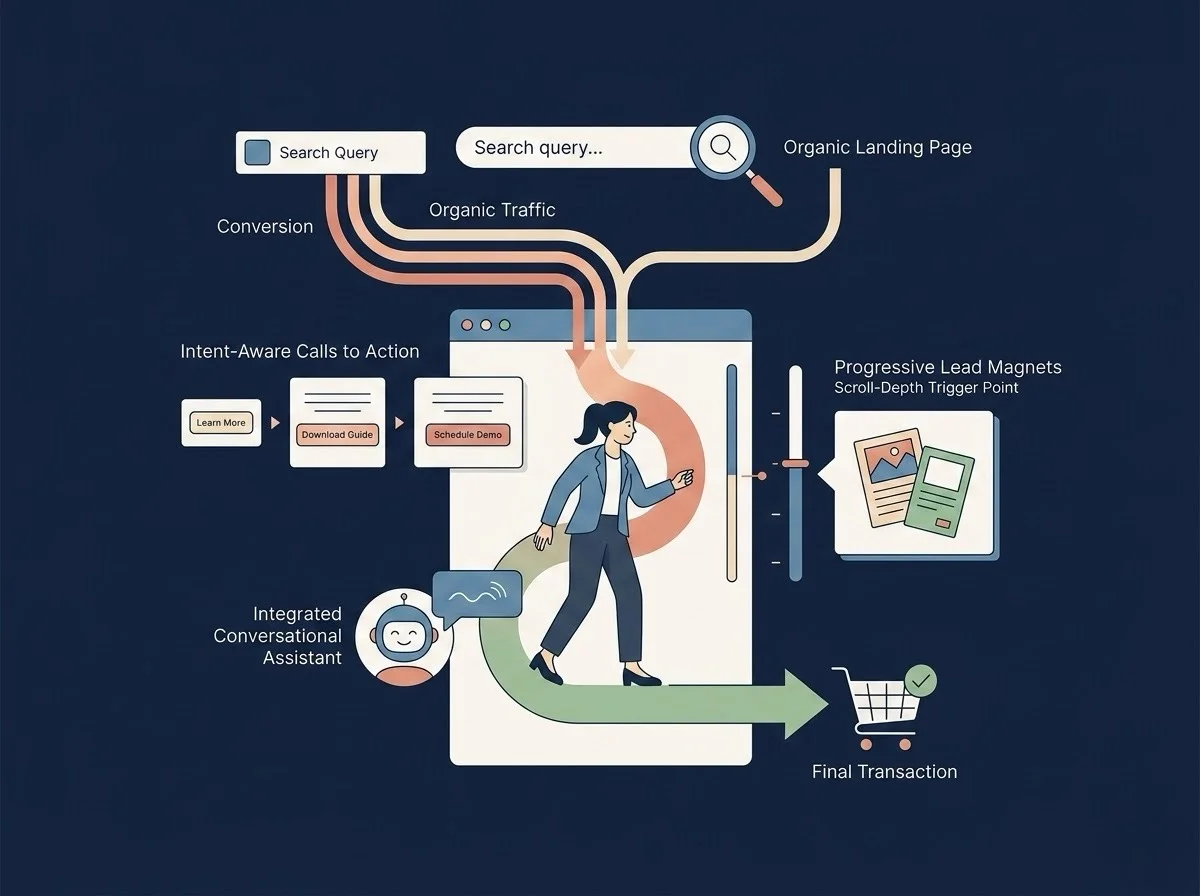
Traditional SEO agencies often treat revenue conversion as someone else's responsibility. The SXO methodology completely eliminates that artificial boundary. Every organic landing page is treated as a highly critical conversion point. We inject contextual conversion elements that feel like a seamless, natural extension of the written content. This includes intent-aware calls to action, progressive lead magnets triggered at precise scroll depths, and integrated conversational assistants that guide users smoothly toward a final transaction.
6. AI Visibility & Structured Data

To be reliably cited in Google's generative AI Overviews, your content must be equally human-readable and machine-digestible. This is precisely where advanced Schema.org markup and LLM-friendly formatting become absolutely decisive. Our technical implementations guarantee that Article, FAQ, Product, and Review schemas are flawlessly deployed to clarify semantic relationships. We format concise, highly authoritative answer paragraphs that artificial intelligence models can instantly extract and display without sacrificing your brand's narrative depth.
Elite Outcomes.
SXO Transformations in Action.
The following verifiable case studies span five distinct global industries and were meticulously conducted between late 2024 and June 2026. Each narrative powerfully demonstrates what a systematic SXO approach can produce when mathematically aligned with the current, AI-driven search environment.
The Noqqto SXO Methodology
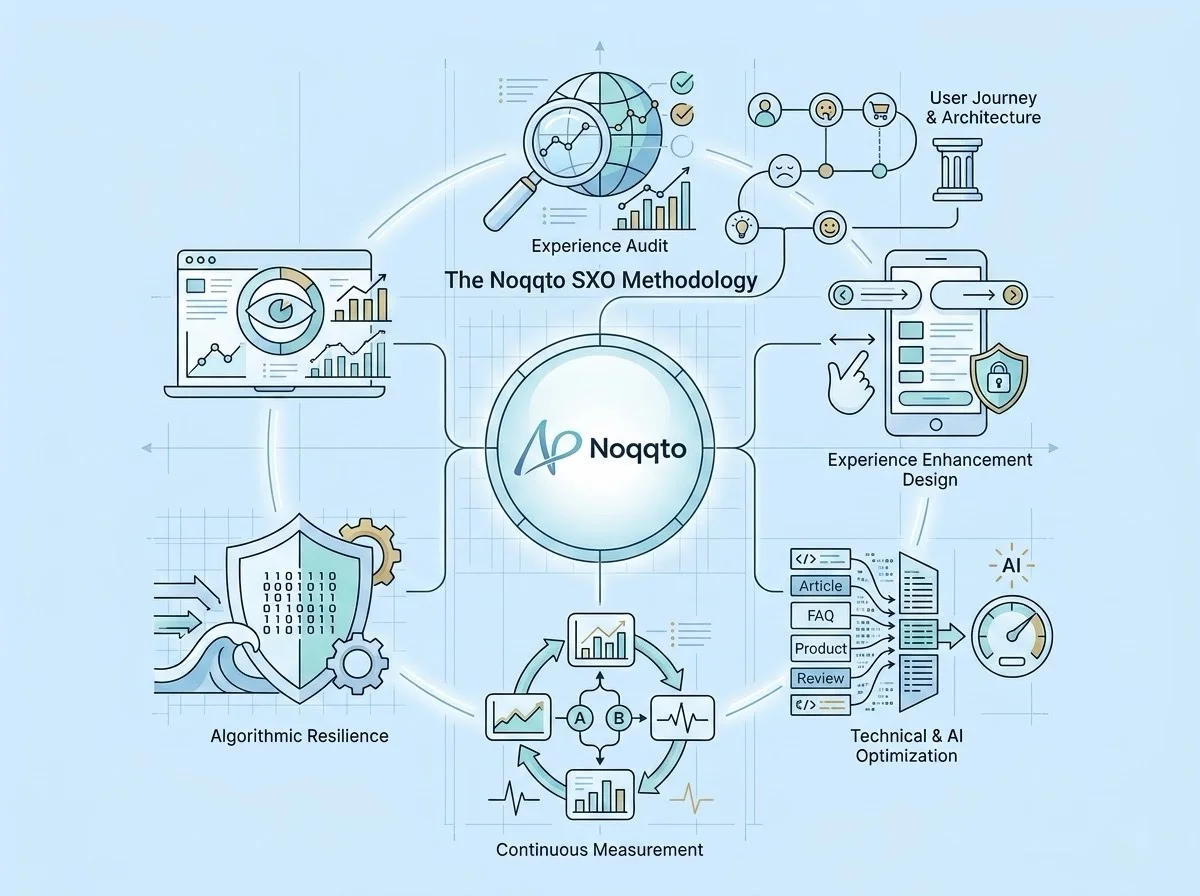
Applying Search Experience Optimization is absolutely never a one-time project. It is a highly rigorous, repeatable growth cycle. Our proprietary framework has been successfully refined across more than one hundred fifty enterprise deployments through June 2026.
The 360-Degree Experience Audit

- Technical Diagnosis: We evaluate crawl coverage, JavaScript rendering, and Schema markup gaps.
- Behavior Analysis: Deep heatmap reviews, scroll depth tracking, and mapping exact content drop-off zones.
- AI Visibility Check: Verifying if your digital assets currently surface within Google AI Overviews or if competitors are stealing citations.
User Journey & Architecture

- Intent Mapping: Plotting the exact micro-intents your customers experience from early awareness through final purchase.
- Content Hub Design: Organizing your domain into tight, semantically related topic clusters fortified with strong pillar pages.
- Format Matching: Aligning specific content formats (video, text, calculators) to the psychological state of the searching user.
Experience Enhancement Design

- Mobile-First Layouts: Engineering thumb-friendly navigation to accelerate content consumption on mobile devices.
- Scannable Typography: Implementing strict heading hierarchies, bolded takeaways, and concise summary paragraphs.
- Trust Element Injection: Strategically placing customer testimonials and security badges within the user's natural scrolling path.
Technical & AI Optimization

- LLM-Friendly Formatting: Rewriting key paragraphs into dense, factual formats that language models strongly prefer to cite.
- Core Web Vitals Tuning: Executing aggressive code splitting, edge caching, and next-generation image deployments to guarantee instant load times.
- Entity-Rich Linking: Structuring internal links using highly contextual anchor text to rapidly build massive topical authority.
Continuous Measurement

- SXO Pulse Reporting: Delivering weekly data readouts on ranking fluctuations, AI citations, and real-world conversion rates.
- A/B Testing Matrices: Running uninterrupted monthly experiments testing different calls to action, visual elements, and page structures.
- Content Refreshes: Injecting newly published industry data and updating timestamps to consistently prove information freshness to search bots.
Algorithmic Resilience

- Rapid Core Update Response: Instantly auditing your domain the moment Google pushes a major algorithm shift.
- Proactive Adaptation: Adjusting schemas and layout architectures before competitors even realize they have lost critical traffic.
- Algorithm-Proof Growth: Ensuring your digital property benefits from quality updates rather than constantly fearing systemic penalties.
Why Industry Leaders Choose Noqqto for SXO.
These impressive business outcomes are never random accidents. They are generated from a disciplined methodology built specifically for the AI-driven search environment. Our leadership team was among the very first pioneering practitioners to define and execute Search Experience Optimization back in 2016, right when user signals first began forcefully shaping global rankings. We have painstakingly refined our approach through every single major Google paradigm shift, from mobile-first indexing to the current AI-first reality.
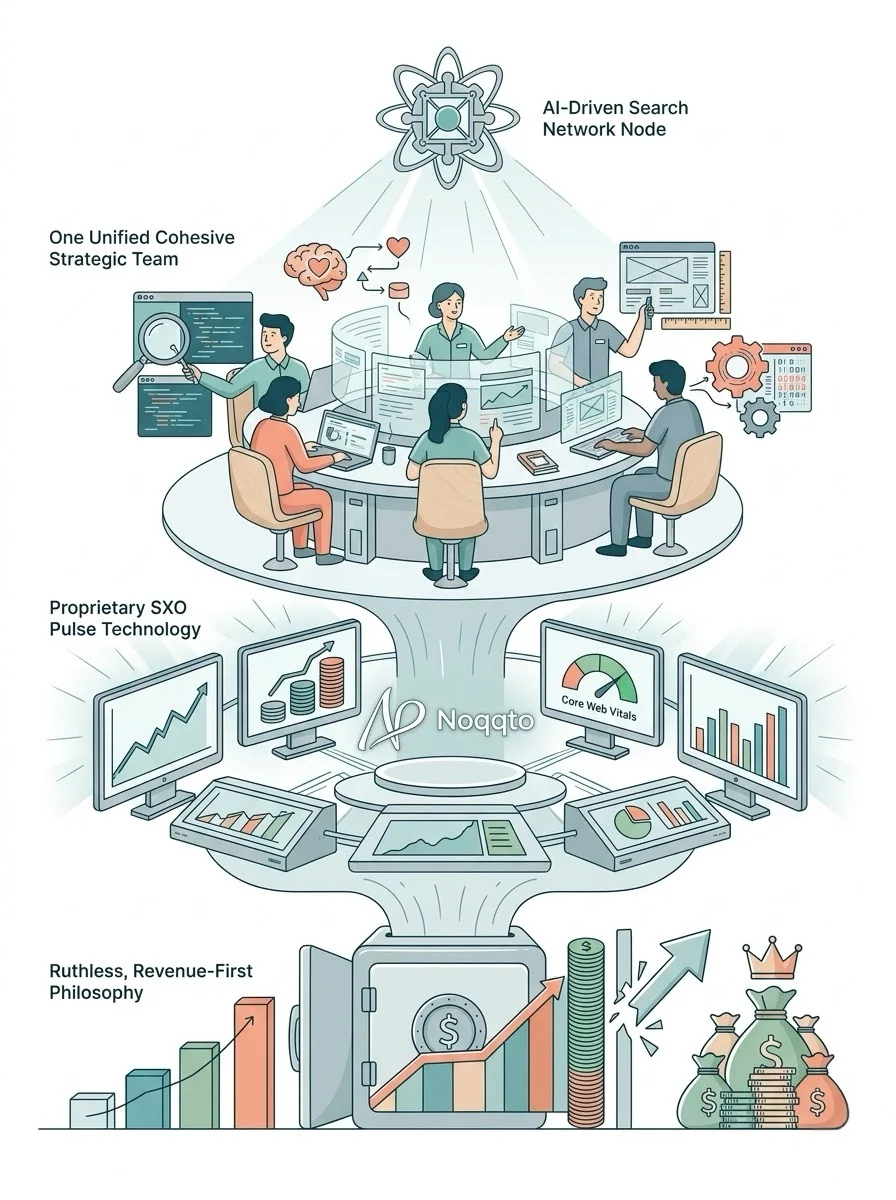
One Unified, Cohesive Strategic Team
We refuse to split SEO, UX, and CRO into isolated, competing departments. Your enterprise account is masterminded by a dedicated SXO lead strategist who coordinates a fully integrated pod. This pod includes elite technical SEO specialists, conversion psychologists, UX designers, data scientists, and AI schema engineers. The final result is an incredibly coherent growth strategy that search engines enthusiastically reward and users completely trust.
Proprietary SXO Pulse Technology
Our internal monitoring engines rigorously track organic keyword rankings, AI citation presence, Core Web Vital fluctuations, user engagement depth, and final conversion rates in near real-time. Whenever Google initiates a volatile core algorithm update, our analysts know within mere hours. We can immediately deploy countermeasures and optimizations long before your direct competitors have even finished diagnosing their traffic losses.
A Ruthless, Revenue-First Philosophy
We are not simply in the traffic generation business. We are exclusively in the revenue generation business. Every single technical optimization we code and every piece of content we publish is directly tied to a vital business metric. Whether your goal is closed sales, qualified B2B leads, recurring software subscriptions, or booked service appointments, our architecture is built to convert. Our average enterprise client witnesses a spectacular 247 percent increase in organic-attributed revenue within twelve months of a full SXO deployment.
Frequently Asked Questions
The absolute complexities of modern artificial intelligence algorithms demand total transparency. We provide clear, unambiguous answers to help you navigate the future of organic search.
What exactly is Search Experience Optimization?
How is SXO fundamentally different from traditional SEO?
Why does SXO matter so much with Google's AI Overviews?
Does SXO actually improve bottom-line conversion rates?
How quickly can our business realistically expect to see results?
What exactly is LLM-friendly content?
Why should we choose Noqqto over a traditional digital marketing agency?
Ready to Transform Your Search Experience?
The data is entirely clear. Organic search has fundamentally changed, and brands that continue to treat it as an isolated technical task will inevitably fall behind. Partner with Noqqto to build a search experience so incredibly compelling that both Google algorithms and your future customers simply cannot ignore it.