
Answer Engine Optimization
for Dominating AI Search.
The digital landscape has fundamentally shifted. For over two decades, the blueprint was simple: rank in the top ten blue links and capture clicks. Today, that playbook is obsolete. We have officially entered the era of the zero-click search driven by Artificial Intelligence. It is time to stop chasing clicks and start dominating the answers.
Request an AI Visibility Audit
Discover exactly how ChatGPT, Google Gemini, and Perplexity currently view your brand entity. We will identify your Retrieval Gaps and map your AEO roadmap.
The Origin of AEO:
How Search Evolved into Synthesis.

Users no longer want a list of websites to browse; they want direct, synthesized, and highly accurate answers delivered instantly. Platforms like Google AI Overviews, Perplexity, ChatGPT, Gemini, and Microsoft Copilot are now the front doors to the internet. They operate as Answer Engines, fundamentally rewiring the psychological expectations of the modern consumer.
If your digital marketing strategy remains entirely focused on classic Search Engine Optimization (SEO), optimizing for keyword density, building arbitrary backlinks, and hoping users click your blue link, your brand is rapidly becoming invisible to a massive segment of the market. Over 60% of traditional searches now result in zero clicks. Businesses must pivot to Answer Engine Optimization (AEO) to survive and thrive. To understand how to execute this pivot, we must comprehensively examine how we arrived at this moment. The origin of Answer Engine Optimization is not a single, isolated event; it is a steady, architectural evolution of machine learning capabilities and human behavior over four distinct phases.
Phase 1: The Literal Keyword Era (1998 to 2012)

In the foundational days of the internet, search algorithms were highly literal and relatively unsophisticated. They operated on lexical search, matching the exact string of characters a user typed in a search bar to the exact string of characters published on a webpage. Content strategy during this era was entirely mechanical. It was about keyword density, exact-match anchor text, and sheer volume.
Because algorithms could not understand human context, the system was easily manipulated by keyword stuffing. A page could rank simply by repeating a phrase like "best CRM software" fifty times. User experience often suffered, as highly ranked pages were frequently unreadable walls of text designed for bots, not humans.
Phase 2: The Semantic Shift & Voice Search (2013 to 2021)

The turning point occurred in 2013 with the introduction of Google's Hummingbird algorithm, which marked the transition from "strings to things." Search engines began analyzing the relationships between words, recognizing synonyms, and attempting to interpret user intent. This semantic shift coincided with the explosion of mobile browsing and Voice Search via Siri, Alexa, and Google Assistant.
When users spoke to their devices, they did not use fragmented, robotic keywords (e.g., "weather new york"). They used natural language and interrogative phrasing (e.g., "What is the weather going to be like in New York tomorrow?"). Marketers realized that securing Position Zero, the featured snippet box at the top of the search results, required structuring content to provide direct, conversational answers. This was the nascent dawn of AEO.
Phase 3: The AI Awakening (2022 to 2024)

The public launch of ChatGPT in late 2022 triggered an extinction-level event for traditional search behaviors. Large Language Models (LLMs) demonstrated that machines could not only retrieve information but understand nuance, retain conversational memory, and generate coherent, human-like synthesis. Consumers immediately realized the inefficiency of opening five different tabs to research a product when an AI could instantly synthesize the core differences in a single, perfectly formatted table.
In a defensive response, traditional search engines accelerated the rollout of generative features. Google launched the Search Generative Experience (SGE), moving AI-generated summaries to the very top of the results page, aggressively pushing organic blue links below the fold. Simultaneously, platforms like Perplexity proved that combining an LLM with real-time web crawling could create a vastly superior research experience.
Phase 4: The Answer Engine Era (2025 to 2026)

By early 2026, the paradigm fully completed its shift from Information Retrieval to Information Synthesis. AI Overviews and chat-based search interfaces have permanently captured the majority of informational and commercial-investigation search volume. The engines do not want to send users to your website; they want to extract your data, cite your brand, and keep the user on their platform.
Optimizing for this ecosystem requires an entirely new discipline. It is no longer about convincing an algorithm that your page is relevant; it is about structuring your raw data so perfectly that an LLM cannot possibly synthesize an answer without referencing your brand as the primary source of truth.
Understanding the Nuance:
SEO vs. AEO vs. GEO

Before executing a modern campaign, marketing executives must distinguish between the three primary optimization frameworks dominating the 2026 landscape. These disciplines are not mutually exclusive; they act as interconnected, synergistic layers of a bulletproof digital ecosystem.
Search Engine Optimization (SEO)
Core Focus: Visibility within standard search indices via technical health, crawlability, traditional backlinks, and keyword density.
Primary Goal: To rank higher in the standard 10 blue links and convince the user to click through to your domain.
Key Metric: Traditional Organic Traffic and Search Impression Share.
The foundation. SEO ensures the bots can find your pages, understand your site architecture, and index your baseline URLs.
Answer Engine Optimization (AEO)

Core Focus: Structuring and formatting exact factual data so AI models (LLMs) can easily parse, extract, and cite your brand as the definitive answer.
Primary Goal: To be explicitly cited by AI platforms, earning trust, entity authority, and direct brand recommendations.
Key Metric: AI Brand Citations, AI-Referred Impressions, and Zero-Click Conversions.
The extraction layer. We format the page so the AI doesn't have to think; it simply copies your data and presents it as absolute fact.
Generative Engine Optimization (GEO)

Core Focus: Influencing the underlying Large Language Model by injecting unique datasets, proprietary research, and profound E-E-A-T signals.
Primary Goal: To fundamentally shape the AI model's internal understanding of your industry, forcing it to view your entity as the market leader.
Key Metric: Share of Voice in Generative Responses and LLM Sentiment Analysis.
The influence layer. Providing original knowledge that the AI requires to generate novel responses, proving you are the primary source.
The 5 Content Clusters of AEO

Succeeding in AEO requires abandoning traditional, long-form narrative blogging. AI tools do not read content end-to-end to appreciate your narrative flow; they scan, evaluate vector proximity, and extract knowledge fragments. To conquer Answer Engines, you must execute these five rigorous architectural clusters.
The BLUF Method & Answer-First Structure

Traditional content relies on lengthy introductions to keep users scrolling. Answer Engines heavily penalize this. You must implement the military-derived Bottom Line Up Front (BLUF) method.
- Extractable Information: Every major section must begin with a direct, uncompromising 1-2 sentence answer to the implied question.
- Semantic Chunking: Break content into modular units of 150-300 words. AI models process modular context significantly faster.
- List Predominance: Utilize bulleted lists and numbered procedures. LLMs natively favor structured arrays for data extraction.
Entity Solidification & Knowledge Graphs

AI models do not "read" websites; they calculate relationships between distinct entities mapped within a massive, multi-dimensional Knowledge Graph. You must define your entity.
- About Us Optimization: Your About page is the primary training document for LLMs. Explicitly state who you are, what you do, and who you serve.
- Digital PR Validation: AI engines rely heavily on third-party corroboration. Secure mentions on high-trust domains to build entity authority.
- Authorship Mapping: Clearly link content to verified human experts with comprehensive digital footprints to satisfy E-E-A-T requirements.
Technical AEO & Schema Architecture

Schema markup (JSON-LD) provides machine-readable context. It strips away aesthetic web design and feeds raw, structured data directly into the AI's processing matrix.
- FAQPage Schema: Wraps frequently asked questions to serve exact Q&A pairs directly to the algorithm.
- Organization Schema: Hard-codes entity details (name, address, global footprint) to prevent AI hallucinations.
- Article & HowTo Schema: Clearly delineates sequential procedures and authorship for step-by-step extraction.
High-Density Content & The Retrieval Gap

If your product pages rely on vague, fluffy marketing copy, the AI cannot confidently retrieve your product for a highly specific query. This failure is known as the Retrieval Gap.
- Extreme Factual Density: Replace marketing adjectives with exact technical specifications, dimensions, and limits.
- Transparent Pricing Data: AI loves comprehensive pricing tiers. Hide your prices, and the AI will recommend a competitor who didn't.
- Explicit Use Cases: Document the exact scenarios where your product excels, allowing the AI to match user constraints perfectly.
Omnichannel Consistency & Freshness

AI models continuously scrape the web to update their weights. If your content is stagnant or contradicts itself across different platforms, you lose entity trust.
- Content Velocity: Regularly inject new statistics, year-stamped data, and recent proprietary surveys into core pages.
- NAP-E Consistency: Ensure your Name, Address, Phone, and Entity description are identical on LinkedIn, directories, and PR releases.
- Information Gain: Always introduce new data points that do not currently exist in the LLM's training set to become the primary source.
Retrieval-Augmented Generation Mastery
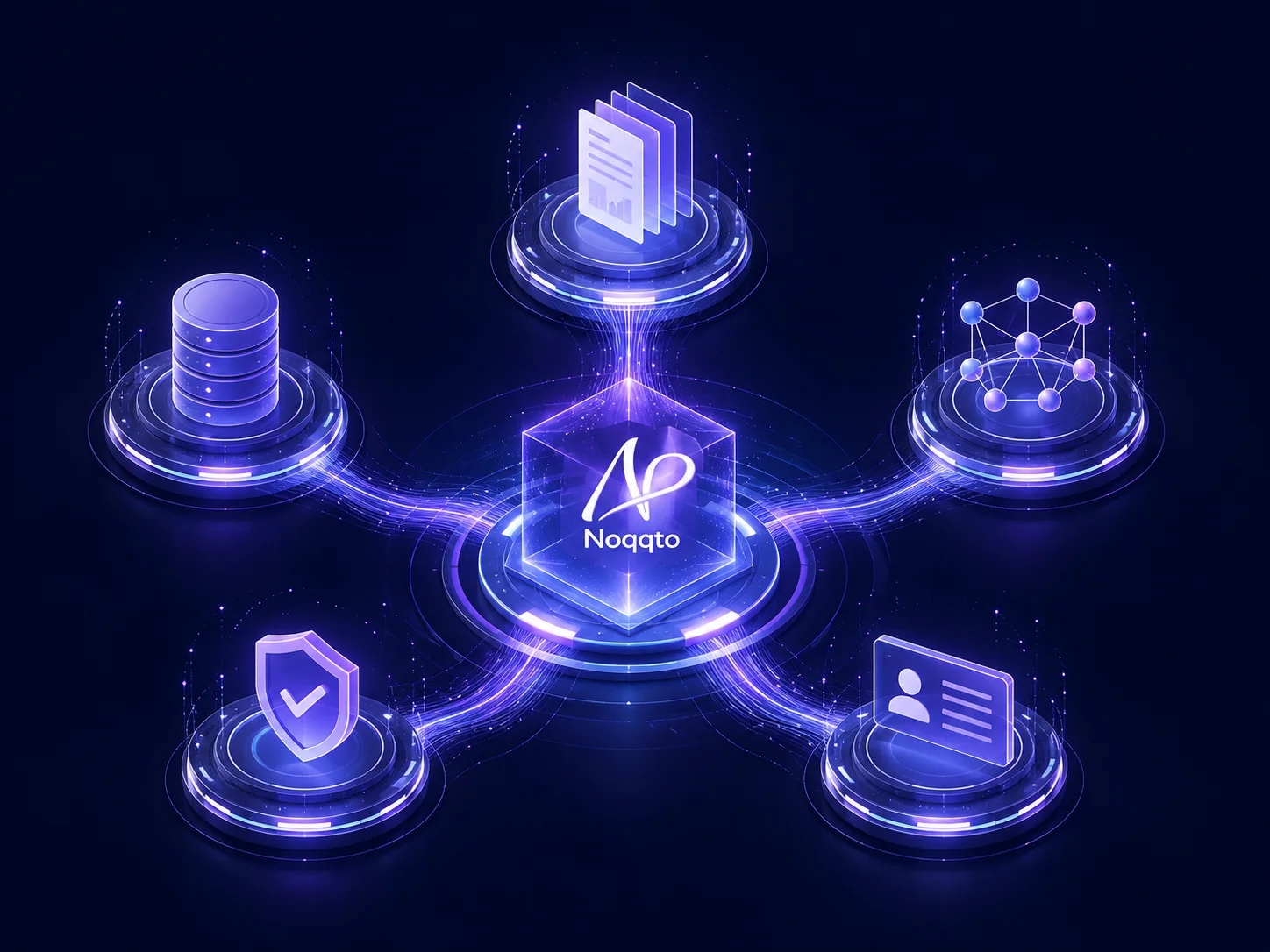
These five clusters represent the blueprint for surviving RAG architectures. By formatting data precisely how machines prefer to ingest it, Noqqto ensures your entity is retrieved during the AI's contextual scanning phase, guaranteeing your brand is featured in the generated output.
Massive Growth Through AEO.
Recent Client Transformations.
The theory of Answer Engine Optimization is compelling, but the real-world mathematical outcomes are staggering. By adapting quickly to the AI landscape, Noqqto has helped enterprise clients across various sectors completely dominate LLM search visibility, recovering traffic lost to zero-click behaviors.
Why Choose Noqqto as Your AEO Agency?
The strategies outlined in this playbook are highly technical, severely resource-intensive, and demand a fundamental overhaul of how your brand communicates with the internet. By the time traditional SEO agencies pivot away from their outdated retainers based on vanity keyword rankings, your agile competitors will have already secured the unbreakable trust of the foundational AI models.
We Are AI-Native Marketers
We did not tack "AI" onto our service page as an afterthought. We completely rebuilt our agency's infrastructure around the unyielding realities of Large Language Models, Vector Databases, and Retrieval-Augmented Generation (RAG). We understand precisely how algorithms like Google Gemini and OpenAI's GPT-4 parse, weigh, and ultimately cite external data.
Proprietary AI Visibility Tracking
You cannot manage what you cannot measure. Because traditional tools (like Google Search Console) fail to report zero-click AI interactions accurately, Noqqto utilizes proprietary tracking methodologies. We mathematically measure Brand Mentions, Sentiment Velocity, and AI Citation Frequency across multiple LLMs, proving the actual ROI of our campaigns beyond clicks.
Holistic Entity Management
AEO cannot be executed in a vacuum. Our cross-functional teams seamlessly integrate Technical Web Development (for Schema), Digital PR (for off-page entity validation), and Content Engineering (for BLUF formatting). We ensure that every digital touchpoint projects a unified, undeniable signal of authority to machine learning models.
The Speed of Execution
The window to establish a first-mover advantage in AI Search is closing rapidly. Once an AI model develops high confidence in a specific entity as the definitive answer, displacing that entity becomes exceptionally difficult. We deploy aggressive, sprint-based roadmaps to restructure your architecture and secure your positioning before your industry peers even understand what AEO is.
AEO Frequently Asked Questions
Transitioning from traditional Search Engine Optimization to an AEO-driven framework raises complex questions. Below is our definitive executive breakdown of Answer Engine mechanics.
What is the exact mathematical difference between SEO and AEO?
AEO is designed to perfectly format and structure your factual content so that Large Language Models can effortlessly read, extract, and inject your information directly into their synthesized, generative answers. SEO is simply about visibility in a list; AEO is about being established as the definitive, undeniable truth in a zero-click ecosystem.
Does the rise of AEO mean traditional SEO is dead?
How do I track AEO success if I am no longer getting website clicks?
Which Schema markups are the most critical for Answer Engines?
- FAQPage: Directly serves the exact Q&A pairs the AI requires.
- Article / BlogPosting: Connects content to verified authorship, establishing vital E-E-A-T (Experience, Expertise, Authoritativeness, Trustworthiness) signals.
- Organization / LocalBusiness: Defines your entity parameters (Name, location, services) to prevent the AI from making factual errors or hallucinations about your business.
- HowTo: Breaks down complex instructions into sequential, machine-readable steps perfect for generative extraction.
Why is my "About Us" page suddenly critical for AEO?
Can I simply use ChatGPT to generate all my AEO content?
What is the BLUF method?
How does Digital PR impact my AEO strategy?
How long does it take to see tangible results from an AEO campaign?
How do I optimize differently for Voice Search vs. AI Chatbots?
Ready to Future-Proof Your Brand?
Stop chasing clicks that no longer exist. Start dominating the answers. Contact Noqqto today for a comprehensive AI Visibility Audit. We will reverse-engineer how the world’s leading Answer Engines view your brand, close your Retrieval Gaps, and deploy a custom AEO roadmap to secure your dominance in 2026 and beyond.