Search Experience Optimization, or SXO, is the discipline that grew out of that uncomfortable realization. It is the practice of optimizing the entire journey, from the search query a person types to the moment they actually do the thing you wanted them to do. Booking the consultation. Calling the number. Filling the form. Buying the dress. Ranking gets you noticed. SXO gets you paid.
This is a long read, and I have written it the way I would explain SXO to a client across a table. We will cover where the term came from, the three years that completely rewrote what it means, the framework I use day to day, and six real case studies from industries I work in: local service providers, healthcare, real estate, individual realtors, cleaning companies, and wedding dress boutiques. The names are kept private, but the work and the numbers are real.

What Search Experience Optimization Actually Means
Let me give you the plain version, the one I would say out loud without any jargon.
Search Experience Optimization is the work of making sure that the people search sends you actually have a good time, and that the good time ends in a result that matters to your business. It sits at the meeting point of three older disciplines. Search Engine Optimization gets you found. User Experience keeps you from frustrating the person once they arrive. Conversion Rate Optimization turns that satisfied visitor into a customer. SXO is the argument that these three were never supposed to be separate teams in separate rooms.
Here is the test I give every business owner. Imagine you rank number one for your most valuable keyword. A perfect, high-intent buyer clicks your link. Three seconds later they hit the back button and click your competitor instead. Did your ranking help you? Of course not. You paid for the visibility and handed the sale to someone else. That back-button moment, which the industry calls pogo-sticking, is one of the most expensive things that can happen on your website, and traditional SEO is completely blind to it.
SXO is not blind to it. SXO treats that moment as the whole point.
So when someone asks me to define it in one breath, I say this: traditional SEO asks "am I visible?" Search Experience Optimization asks "am I useful, fast, clear, and worth choosing?" The second question is harder. It is also the only one that pays the bills in 2026.

Where SXO Came From: A Short Honest History
SXO is not a brand new invention, and anyone who tells you it appeared overnight is selling you something. The term itself was coined around 2015, mostly as a way to describe what the best SEO practitioners were already quietly doing. They had figured out, ahead of the tools and ahead of the conferences, that what looked like a ranking problem was very often a usability problem wearing a costume. A page that ranked but did not convert was not a content failure. It was an experience failure.
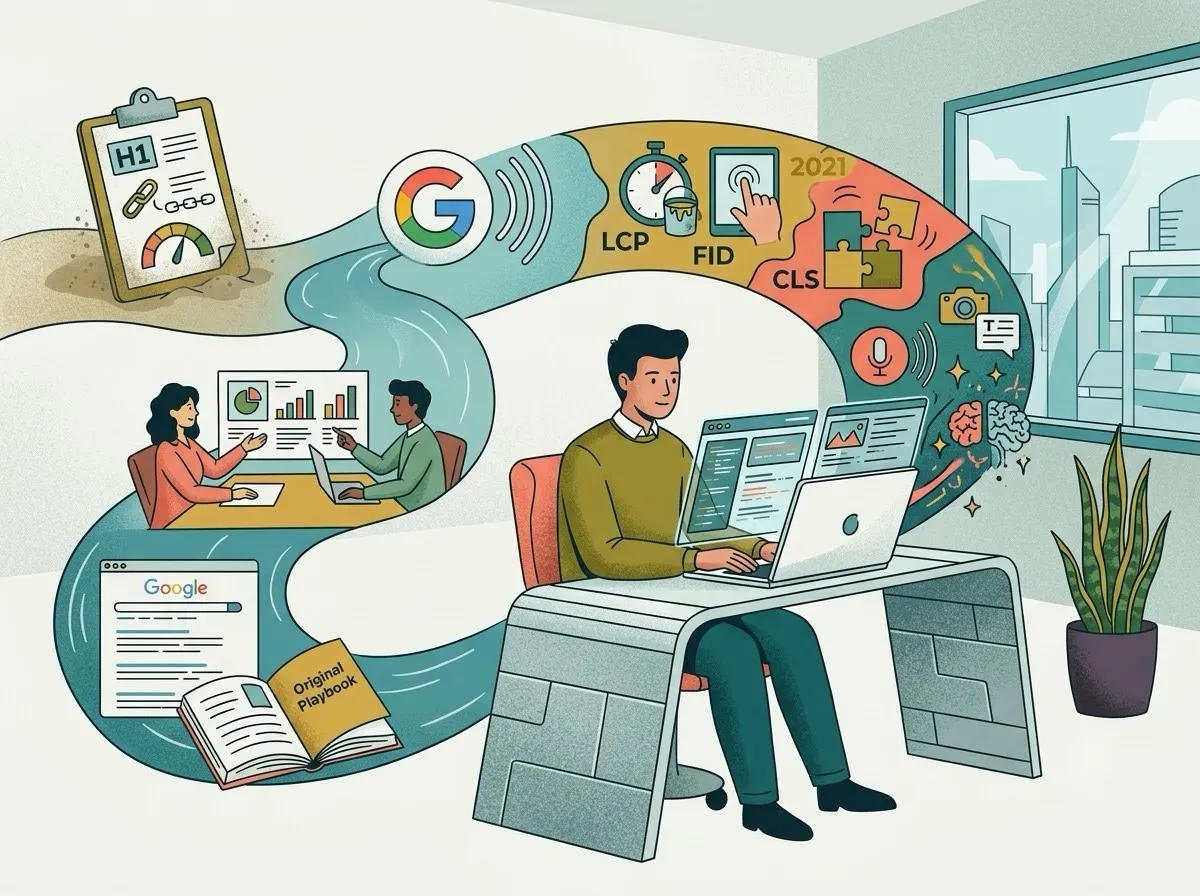
For years, this idea lived on the edges. The checklists ruled instead. Most agencies sold SEO as a tidy list of tasks: fix the H1 tags, hit a keyword density, repair the broken links, chase the backlinks. Useful, but incomplete. None of it asked whether a human being could find the phone number on a mobile screen without squinting.
Then Google forced the issue. The Page Experience update, which rolled out in 2021, did something the industry could not ignore. It formally turned user experience signals into ranking factors. Suddenly how fast your page loaded, how stable it was as it rendered, and how quickly it responded to a tap were not just nice-to-haves for designers. They were inputs to your rankings. Google introduced Core Web Vitals to measure exactly this, and the conversation around SXO went from a fringe idea to a boardroom topic almost overnight.
That was the setup. The world still mostly revolved around one judge, Google, ranking ten blue links. If you optimized your experience for Google and for the human, you were in good shape. The original SXO playbook was written for that world.
That world is gone now. And the thing that ended it is the reason I am writing this guide in 2026 instead of recycling something from 2021.
The Three Years That Rewrote Everything
If you want to understand why SXO matters more today than it ever has, you have to look at what happened between late 2022 and now. I lived through every month of it with clients, and it genuinely felt like the ground moving under our feet. Let me walk you through it the way it actually unfolded.
It started with conversational AI going mainstream. When ChatGPT landed in front of ordinary people, the way humans asked questions began to shift. People stopped typing fragments like "best dentist Dallas reviews" and started asking full questions, in full sentences, the way they would ask a knowledgeable friend. That alone changed how content had to be structured to be found.
Then the search engines themselves changed. Google moved from its search experiments into AI Overviews, those generated answer boxes that now sit above the traditional results for a huge share of queries. Perplexity, Gemini, Claude, and ChatGPT became genuine research tools that millions of people use before they ever touch a classic search results page. The blue links did not disappear, but they got pushed down, and for many questions they stopped being the first thing anyone saw.
The consequence of all this is the single most important number in modern search. By 2026, more than 60 percent of searches end without anyone clicking through to a website at all. The answer was served right there, in the AI summary or the snippet, and the journey ended before it reached anyone’s homepage. For top-of-funnel, informational questions, that figure climbs even higher. The era of free, easy, top-of-funnel traffic is closing.
This is where a lot of business owners panic, and I understand why. But here is the reframe I give every client, because it is the truth. If fewer clicks are coming, then every single click that does come is now far more valuable than it used to be. The people who still click through after reading an AI summary are deeper in their decision, closer to buying, and harder won. You cannot afford to waste them. A wasted click in 2026 costs you more than three wasted clicks did in 2021.
That is exactly the gap Search Experience Optimization fills.
A few technical things shifted underneath the surface too, and they matter. In March 2024, Google replaced its old responsiveness metric with Interaction to Next Paint, or INP, as a core measure of how quickly your site reacts when a person actually taps or clicks something. The good threshold is under 200 milliseconds. Largest Contentful Paint, which measures how fast your main content appears, needs to land under 2.5 seconds. Cumulative Layout Shift, which measures whether your page jumps around annoyingly as it loads, needs to stay under 0.1. These are not abstract developer metrics. They are direct ranking signals and direct experience signals at the same time. A site that fails them is failing Google and failing humans in the same breath.
The newest shift, the one defining 2026, is the strangest of all. We are no longer optimizing only for a human being or only for a search engine crawler. We are increasingly optimizing for an AI agent that visits your site on behalf of a human. Someone asks an assistant to find them a wedding dress boutique with availability next month, and the assistant goes and reads sites the way a person would, judging clarity, structure, and trust, then reports back. I call this machine-to-machine trust. Your website has become a structured repository of value that an AI has to be able to navigate and believe in. If your information is buried, contradictory, or slow, the agent moves on, and you never even knew the opportunity existed.
So the three-year story, compressed, is this. SXO used to mean making humans and Google happy. Now it means making humans, Google, AI answer engines, and the AI agents acting for people all happy at once. The discipline did not get easier. It got essential.

The SXO Framework I Actually Use
When I take on a new project, I do not start by guessing. I run the experience through five layers, in order, because a failure in an early layer makes everything after it pointless. You cannot optimize a checkout for a person who never reached it.
Layer one is discoverability. Can search engines and AI engines find, crawl, understand, and trust your pages in the first place? This is the foundation that classic SEO services handle: clean technical structure, logical site architecture, structured data, and content that genuinely matches what people are searching for. If this layer is broken, nothing else gets a chance.
Layer two is click-worthiness. When you do appear, whether as a blue link, a featured snippet, or a citation inside an AI answer, are you the result a person chooses to click? This is where titles, meta descriptions, schema, and reputation signals do their work. In an age of fewer clicks, earning the click is its own skill.
Layer three is the landing experience. This is the first five seconds after the click, and it decides more than people realize. Does the page load fast? Does it match exactly what the person expected when they clicked? Is the thing they came for visible without scrolling and hunting? This is where Core Web Vitals live, and where most of the pogo-sticking damage happens.
Layer four is task completion. Can the person actually do what they came to do, easily, without friction or confusion? This is the heart of what conversion rate optimization is built to solve: clear calls to action, short forms, obvious next steps, and zero dead ends. A good SXO page always answers the question "what should I do next?"
Layer five is the feedback loop. Every behavior on your site is data. Where people stop, where they rage-click, where they hesitate, where they convert. SXO is never finished. It is a loop of measuring real human behavior and feeding it back into the next round of improvements.
Most businesses I audit are strong in one layer and quietly broken in another. A clinic with brilliant content and a five-step booking form. A boutique with stunning visuals and a six-second load time. SXO is the practice of fixing the whole chain, not the loudest link.

How SXO Fits With SEO, AEO, GEO, AIO, and Everything Else
People get understandably confused by the alphabet soup, so let me draw the map clearly, because it also explains why these are separate services rather than one blurry thing.
Think of SXO as the umbrella that cares about the human’s entire experience of finding and using you. The other disciplines are specialists that feed into it.
Search Engine Optimization is the foundation. It earns the visibility in classic search that the whole experience starts with.
Answer Engine Optimization, or AEO, structures your content to win featured snippets, People Also Ask boxes, and voice search answers. It is about being the direct answer to a direct question.
Generative Engine Optimization, or GEO, positions your brand inside the answers that tools like ChatGPT, Claude, Perplexity, and Google’s AI Overviews generate. When an AI synthesizes a response, GEO is the work that gets you cited rather than ignored.
Artificial Intelligence Optimization, or AIO, and our closely related AI SEO practice, build the deeper semantic and entity relationships that make AI platforms recognize your brand as a trustworthy authority worth recommending.
Conversion Rate Optimization sharpens the moment of decision, turning visitors into customers through testing and behavioral analysis.
And the experience itself has to live somewhere fast and well-built, which is where premium web development comes in. You cannot bolt good Core Web Vitals onto a bloated, poorly built site as an afterthought.
Here is the relationship in one sentence. AEO, GEO, AIO, and SEO get you in front of the right person across every search surface that exists today. SXO makes sure that once you are in front of them, you win. If you want the dedicated, conversion-obsessed version of this work, that is exactly what our Search Experience Optimization service is built to deliver. This guide is the education. The service is the execution.
Now let me show you what this looks like when it meets real businesses.

Six Real Case Studies From the Front Lines
These are anonymized, but the situations, the levers we pulled, and the results are drawn from real client work. I chose these six industries on purpose, because they show how the same SXO principles play out very differently depending on who is searching and why.
Local Service Provider: The HVAC Company With Traffic and No Phone Calls
A heating and cooling company came to me ranking respectably for terms like "furnace repair" in their city. On paper they were winning. In reality, their phone was quiet, and they could not understand why.
The audit told the whole story in about ten minutes. Their mobile site took nearly five seconds to show its main content, which is an eternity for someone standing in a cold house at night with a broken furnace. The phone number was buried in a header that collapsed on mobile. There was no click-to-call button anywhere. And every city page read like generic filler, not like a company that could actually show up tonight.
The fixes were pure SXO. We rebuilt the pages to load in under two seconds. We added a sticky click-to-call bar that followed the user down every page. We put a live "available now" badge near the top, added real photos of the actual technicians and their trucks, and pulled genuine reviews up right next to the call button where anxious customers could see them. Then we built intent-specific landing pages that matched the panic of the moment, things like "furnace not working at night."
Within a single heating season, their inbound calls roughly tripled, their cost per lead dropped sharply, and after-hours emergency bookings became a real revenue stream instead of a missed opportunity. They were also running Google Ads, and the same speed and clarity fixes quietly improved those campaigns too, because a faster, intent-matched landing page converts a paid click just as well as an organic one. Same rankings. Completely different business. The traffic was never the problem. The experience after the click was.

Healthcare: The Physiotherapy Clinic That Looked Clinical and Felt Cold
A physiotherapy and sports injury clinic ranked well for the obvious "physiotherapy" plus city searches, but their online bookings were thin. People were finding them and leaving.
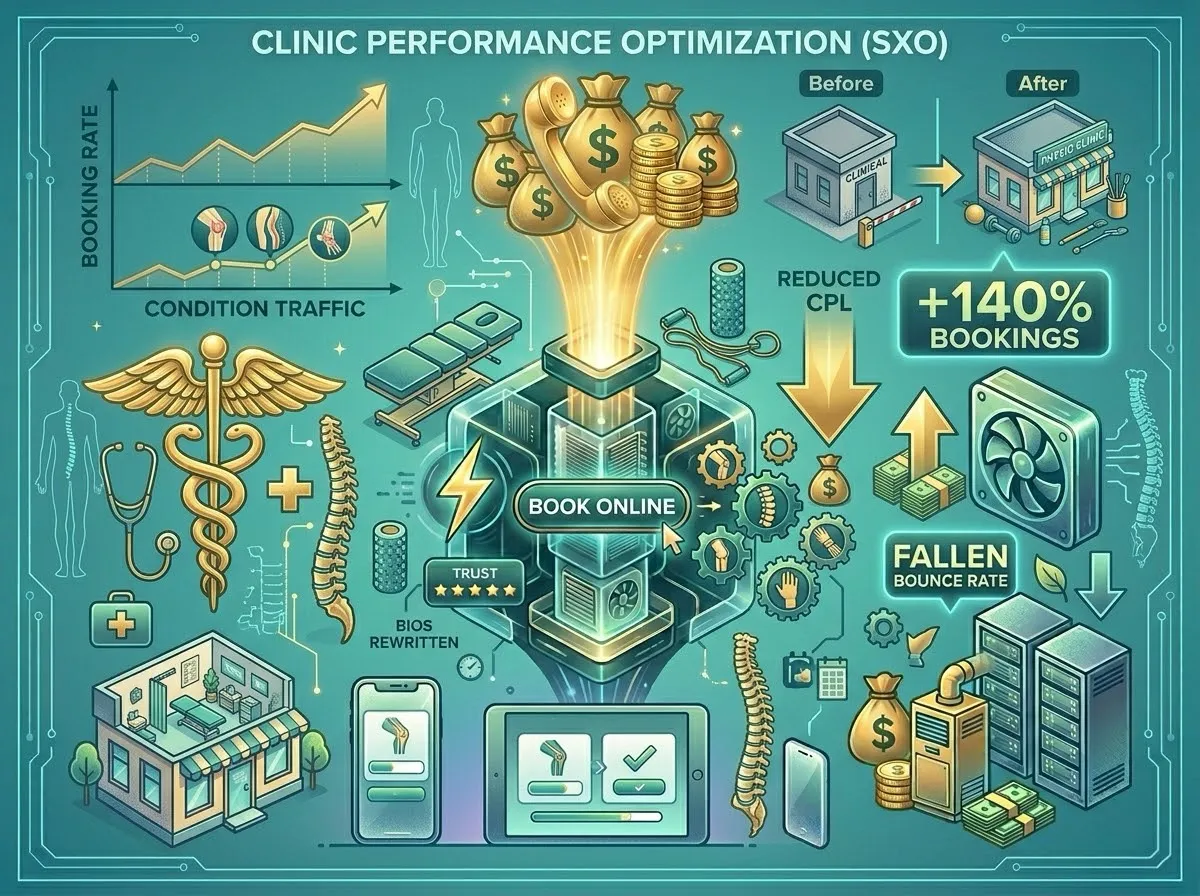
When I went through the site as if I were an injured runner in pain, the problems jumped out. The booking flow ran five steps deep before you could actually reserve anything. There were no pages explaining specific conditions, so someone searching for "runner’s knee" or "sciatica relief" never found a home that spoke to their exact problem. The tone was stiff and clinical in a way that quietly intimidated nervous patients. And there was no clarity at all on insurance or pricing, which is the first question anyone in pain wants answered.
We rebuilt the experience around the patient’s real anxiety. We created clear, reassuring condition pages that matched how people actually search and described symptoms in human language. We cut the booking flow from five steps to two. We added straightforward insurance and pricing information up front. We rewrote the therapist bios to highlight real credentials and experience, which matters enormously for trust in healthcare, both for humans and for the AI systems that now weigh expertise heavily. And we added a frequently asked questions section answering the nervous questions, like whether the first session would hurt.
Online bookings climbed by around 140 percent, the bounce rate fell, and the clinic started attracting much higher-intent traffic from people searching for the specific conditions they specialized in treating. Good SXO in healthcare is mostly the work of replacing intimidation with clarity.
Real Estate: The Boutique Brokerage With Beautiful, Broken Pages
A boutique brokerage handling high-end listings had a website that looked stunning in a portfolio screenshot and performed terribly in real life. Their listing pages, loaded with gorgeous high-resolution photography, took more than six seconds to become usable. The mortgage calculator was buried. There were no neighborhood guides. And on a phone, where most property browsing actually happens, the whole thing felt sluggish and heavy.
The irony of luxury real estate is that the very thing meant to impress, the imagery, was the thing driving buyers away. So we attacked the weight. We implemented smart image optimization and lazy loading that brought the pages under two seconds without sacrificing the visual quality that mattered for premium listings. Then we built out the missing research layer: detailed neighborhood guides that captured all the people searching to understand an area before they ever look at a specific home. We added saved-search functionality and a clean, obvious inquiry call to action, and we structured the listings so search engines could parse them properly.
Qualified inquiries rose, time on site went up as people actually explored, and the neighborhood content started pulling in a steady stream of organic research traffic that fed directly into the listings. This was a case where the brokerage already had the traffic-earning visibility handled and needed the conversion side of the equation rebuilt around how buyers really behave.

Individual Realtor: Competing Against the Giant Portals
This one is close to my heart, because individual agents have it hard. A solo realtor was trying to build a personal brand while competing against enormous property portals with limitless budgets. His site was thin, slow, and generic. It had a "contact me" form and not much else, and his reviews, which were excellent, were nowhere to be seen.
You cannot out-spend the portals, so you have to out-specialize them. We leaned hard into hyperlocal content, building genuinely useful guides like "moving to" a specific suburb, with the kind of street-level detail the big portals never bother with. We added short video walkthroughs that let his personality come through, surfaced his glowing testimonials prominently, and replaced the cold contact form with a simple, low-commitment "book a 15-minute call" button. We also aligned everything with his Google Business Profile so his local presence was consistent.
Direct inquiries went up, his reliance on expensive portal leads dropped, and he started ranking for neighborhood-specific long-tail searches that the portals were too broad to win. For an individual realtor, SXO is the art of being unmistakably the local human expert, both in the eyes of a searcher and in the eyes of an AI deciding who to recommend in that specific neighborhood.

Cleaning Services: The Quote Form Nobody Finished
A residential and commercial cleaning company ranked for "house cleaning" plus their city, but their bounce rate was painful and their quote requests were few. People arrived and bolted.
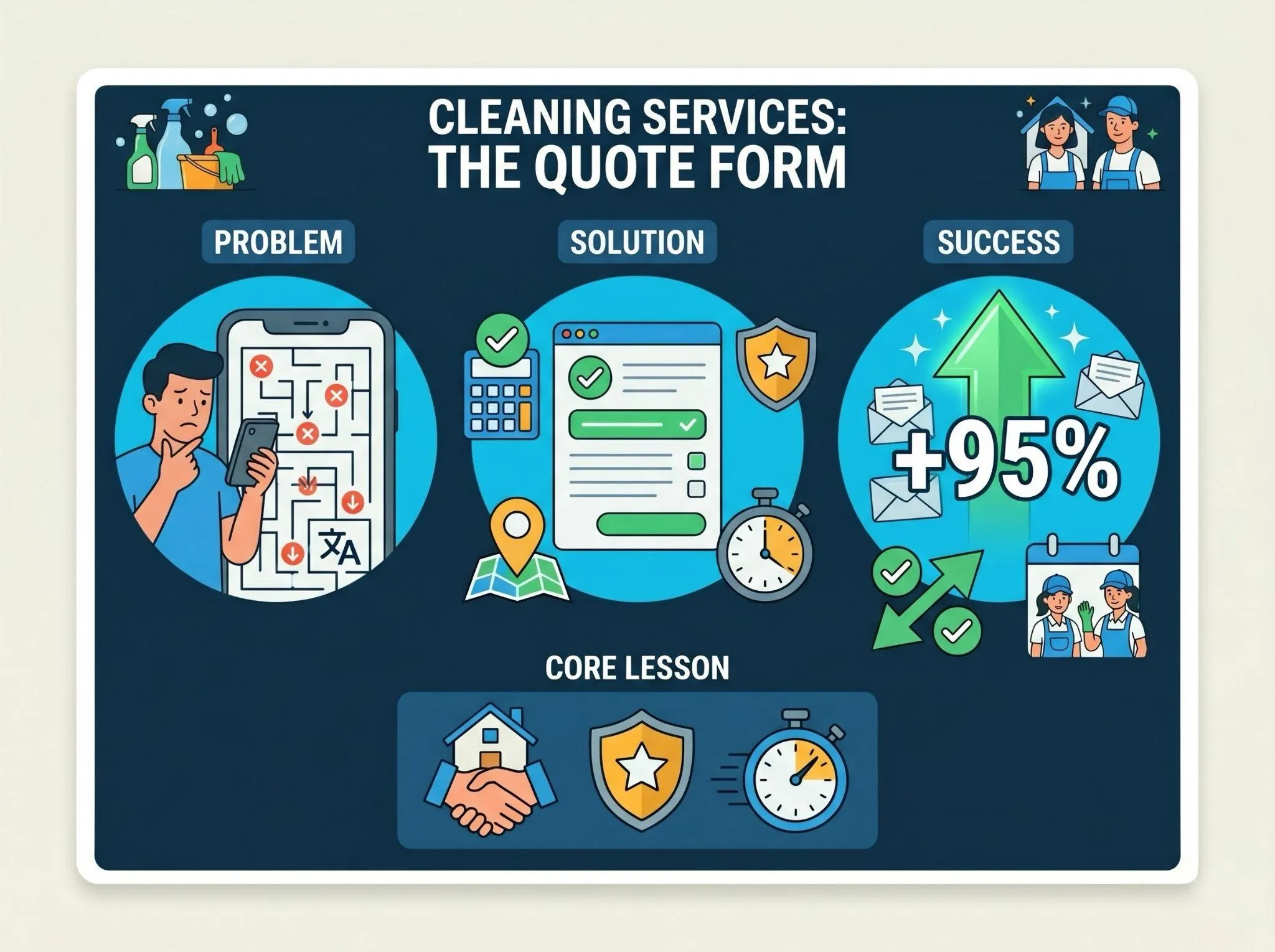
The diagnosis was a textbook SXO breakdown. There was no instant pricing, so visitors had no idea whether the service fit their budget. The quote form was long and demanding, asking for far too much before offering any value. Nowhere did the site clearly say the company was insured and bonded, which is the exact reassurance someone needs before letting strangers into their home. The mobile experience was slow, and the service areas were unclear, so people in the suburbs could not tell if they were even covered.
We rebuilt around trust and speed. We added an instant quote estimator that gave people a ballpark in seconds. We cut the quote form down to the essentials. We put "insured and bonded" and real customer reviews front and center near every call to action. We built clear service-area pages so people in each neighborhood knew they were covered, and we added a simple click-to-book option for people ready to commit.
Quote requests rose by roughly 95 percent, the conversion rate doubled, and recurring booking sign-ups, which are the real prize for a cleaning business, climbed steadily. The lesson here is universal: when you ask a stranger to trust you in their home, you remove friction and add reassurance at every single step.
Wedding Dress Boutique: A Gorgeous Instagram and an Invisible Website
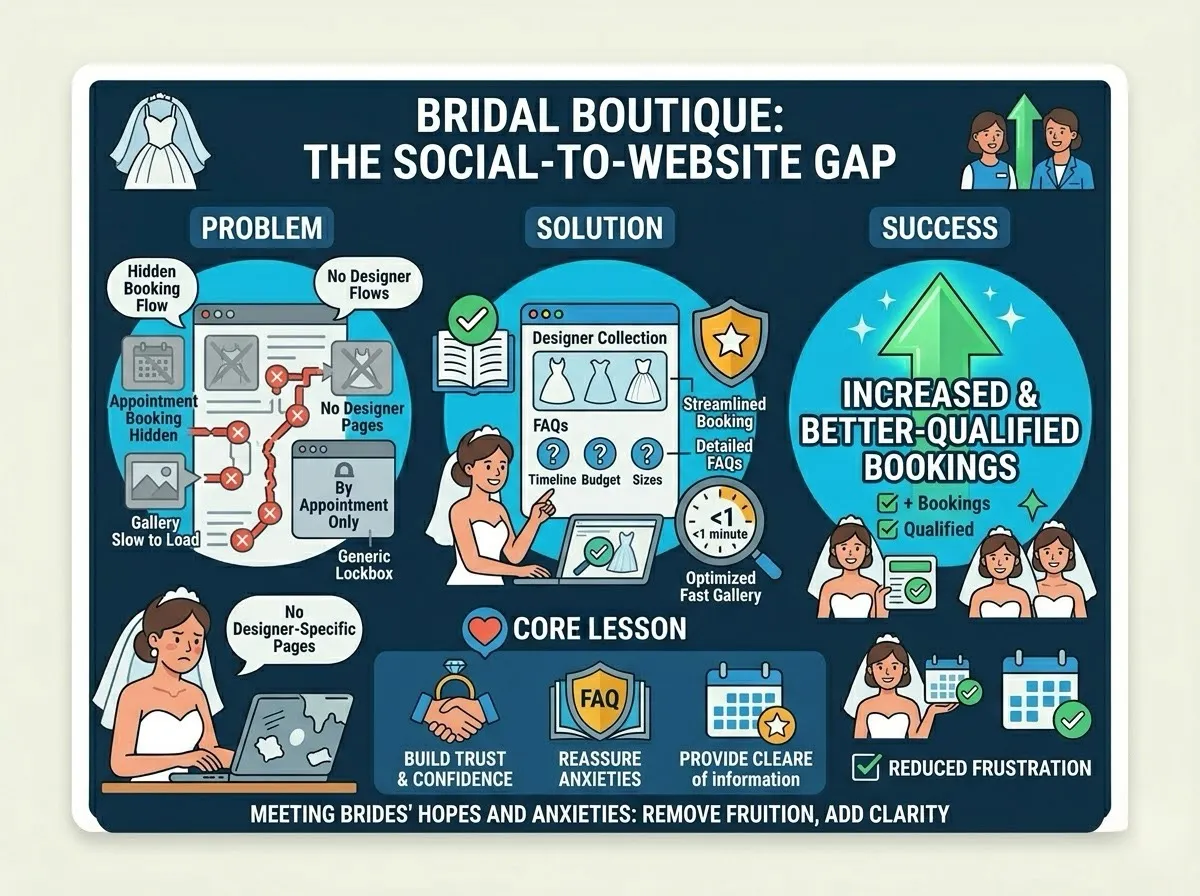
A bridal boutique had a beautiful, thriving Instagram presence, the kind of social media marketing that fills the top of the funnel with eager brides, and a website that quietly undermined all of it. Their appointment booking was hidden. They had no pages built around the designers and collections they carried, so they were invisible for searches like a specific designer’s name plus the city. The gallery was slow to load. There was no information about alterations, timelines, or budgets, and the "by appointment only" message, with no further clarity, read as intimidating rather than exclusive.
Bridal is an emotional, high-consideration purchase, and SXO in this space is about meeting a bride’s hopes and anxieties at the same time. We built dedicated collection and designer pages that captured all the brides searching for specific labels in the area. We streamlined the appointment booking into a clean calendar flow so a bride could reserve a fitting in under a minute. We added a thorough frequently asked questions section covering the real worries: how far ahead to shop, typical budgets, plus-size availability, and how alterations work. We optimized the galleries so the dresses loaded fast and looked perfect, and we featured real brides and genuine reviews to build trust.
Appointment bookings rose, and just as importantly, the brides who booked were better qualified, arriving with the right budget expectations, which meant fewer mismatched appointments and fewer no-shows. The boutique stopped losing brides to the gap between a beautiful Instagram feed and a frustrating website. We closed that gap, which is exactly what Search Experience Optimization is for.
How to Actually Start With SXO
If you are reading this as a business owner and wondering where to begin, here is the honest, practical order I would put you in. You do not need to do everything at once. You need to do the right things first.
Start by measuring the truth. Before you change anything, find out how your pages actually perform for real users. Check your Core Web Vitals, watch session recordings, and look at where people are dropping off. You cannot fix an experience you have not honestly looked at.
Fix speed and stability next, because they sit underneath everything. If your most important pages do not load fast and stay stable, every other improvement is built on sand. This is often where a serious web development effort earns its keep, because some speed problems cannot be patched and need to be properly engineered.
Then match intent ruthlessly. Go through your key pages and ask, for each one, whether it delivers exactly what someone clicking from search expected, within the first screen, without hunting. Mismatched intent is the quietest killer of conversions.
After that, remove friction from the one action that matters most on each page. Shorten the form. Make the button obvious. Add the trust signal next to the decision. Answer the nervous question before it is asked. Then, and only then, get into the testing loop, where you let real behavior tell you what to improve next.
The order matters. I have watched too many businesses A/B test the color of a button on a page that takes six seconds to load. Fix the foundation first.

The Mistakes I See Most Often
A few SXO failures show up again and again, across every industry, so let me save you from them.
The first is optimizing for the crawler and forgetting the human. Plenty of sites are technically perfect and emotionally dead. They tick every SEO box and give the visitor no reason to stay.
The second is the dead end. A page that answers a question and then leaves the person stranded, with no clear next step, no related help, no call to action. Good SXO never abandons the user at a dead end.
The third is the friction nobody notices because they are too close to it. The owner knows exactly where the booking button is, so it never occurs to them that a first-time visitor cannot find it. This is why outside eyes and real session data matter so much.
The fourth is treating SXO as a one-time project. It is a loop, not a launch. Search behavior, AI engines, and user expectations keep moving, and the experience has to keep moving with them.
And the fifth, increasingly costly in 2026, is ignoring the AI layer entirely. If your content is unstructured, contradictory, or buried, you are invisible to the answer engines and the AI agents that more and more people now rely on to make decisions for them.

The Road Ahead
I do not have a crystal ball, but the direction of travel is clear enough that I will say this with confidence. The line between SEO and experience, already blurry, is going to disappear completely. As AI engines and AI agents take over more of the discovery process, your website increasingly has to satisfy two judges at once: the human who will feel your design, and the machine that will parse your structure on that human’s behalf. The brands that win will be the ones that treat clarity, speed, trust, and usefulness not as marketing tactics but as the product itself.
The good news is that this rewards exactly the right behavior. There are no more shortcuts. You cannot trick your way to a good experience. You have to actually build one. And if you do, you become the answer that both humans and machines keep choosing.
That is the entire promise of Search Experience Optimization. Ranking was never the finish line. The click is where the work begins.
Frequently Asked Questions About Search Experience Optimization
Q: What is Search Experience Optimization (SXO) in simple terms?
SXO is the practice of optimizing the complete journey from a search query to a completed action, not just the ranking. It combines Search Engine Optimization, User Experience design, and Conversion Rate Optimization into one connected discipline. In plain language, SEO gets a person to your website, and SXO makes sure that once they arrive, they have a fast, clear, trustworthy experience that ends in them becoming a customer.
Q: How is SXO different from SEO?
SEO focuses on visibility, getting your pages to rank and appear in search results. SXO includes that visibility but extends responsibility to everything that happens after the click: page speed, clarity, ease of use, and whether the visitor actually converts. The short version is that SEO asks "am I visible?" while SXO asks "am I visible, useful, fast, and worth choosing?" You need both, but only SXO connects rankings to revenue.
Q: Is SXO going to replace SEO?
No. SXO does not replace SEO, it absorbs it and builds on top of it. Search Engine Optimization remains the essential foundation that earns your visibility in the first place. SXO simply argues that visibility without a strong experience is wasted, so it extends the work to cover the full journey. Think of SEO as the front door and SXO as making sure the whole house is worth walking into.
Q: Why does SXO matter more in 2026 than it did a few years ago?
Because more than 60 percent of searches now end without a click, thanks to AI Overviews and AI answer engines serving responses directly. That means every click that does reach your site is far more valuable and harder won than before. You cannot afford to waste high-intent visitors on a slow or confusing experience. SXO ensures that the fewer, more valuable clicks you receive actually convert at a much higher rate.
Q: How do search engines measure search experience?
They track post-click behavioral signals such as how long visitors stay, whether they bounce straight back to the results, and how deeply they engage with your site. They also rely heavily on Core Web Vitals: Largest Contentful Paint for loading speed, which should be under 2.5 seconds, Interaction to Next Paint for responsiveness, which should be under 200 milliseconds, and Cumulative Layout Shift for visual stability, which should stay under 0.1. These are direct ranking and experience signals at the same time.
Q: What is pogo-sticking and why is it so damaging?
Pogo-sticking is when a person clicks your search result, dislikes what they find, immediately hits the back button, and clicks a competitor instead. It is one of the most damaging behaviors for your business because it signals to search engines that your page failed to satisfy the searcher, and it hands the sale straight to a rival. Strong SXO, with fast loading, intent-matched content, and a clear next step, is the most effective defense against it.
Q: Does SXO help with AI search engines like ChatGPT and Perplexity?
Yes, significantly. AI models prefer to cite and recommend sources that are fast, cleanly structured, clear, and authoritative, which are the exact qualities a strong SXO foundation builds. A well-optimized experience reduces clutter and makes your factual content easy for AI systems to parse and trust. This is also where related disciplines like Generative Engine Optimization and Answer Engine Optimization work hand in hand with SXO.
Q: Which types of businesses benefit most from SXO?
Honestly, any business that depends on its website to generate leads or sales benefits, but the impact is especially dramatic for local service providers, healthcare practices, real estate firms and individual realtors, home service companies like cleaners, and appointment-based businesses such as wedding dress boutiques. These businesses live and die on whether a searcher trusts them enough to call, book, or visit, which is precisely what SXO optimizes for.
Q: How long does it take to see results from SXO?
Some wins arrive quickly. Fixing critical speed problems, clarifying a confusing booking flow, or adding trust signals can lift conversions within weeks, because you are improving the experience for traffic you already have. Deeper compounding gains, where improved behavioral signals also strengthen your rankings and AI visibility, generally build over three to six months. The exact timeline depends on your starting point, your competition, and how much of the foundation needs rebuilding.
Ready to stop leaking revenue after the click? Our team can audit your full search experience and turn the traffic you already have into customers. Explore our Search Experience Optimization services or book a consultation to talk it through.