Fast forward to 2026, and the ground isn't just shifting under our feet. It's completely cracked open.
If you've been staring at your analytics dashboards lately, feeling a creeping sense of anxiety as your organic click-through rates slip while your keyword rankings stay perfectly stable, you're not losing your mind, and you're also not alone in wondering whether SEO is still relevant for AI search. The classic conversion funnel is broken. We've officially entered the era of the zero-click search, driven by autonomous multi-agent consensus networks, Retrieval Augmented Generation (RAG) engines, and real-time conversational synthesis.
As a recent 2026 industry analyses report, nearly a third of the US population will use generative AI search this year, pushing marketers to build real SEO for generative AI into their playbooks and optimize for platforms like ChatGPT, Google AI Overviews, and Perplexity alongside traditional search engines. At Noqqto, we spent the better part of last year realizing our old playbooks weren't just underperforming; they were completely invisible to the systems that now gatekeep the internet. To survive, we had to stop optimizing for standard index databases and start optimizing for AI search visibility across generative synthesis layers.

Below is the raw, unfiltered story of how we pulled apart our entire operational workflow, the exact framework we engineered to win citations inside AI search models, and the real data behind how this strategy drove our highest performance milestones to date.
The Day the Metrics Lied: A Veteran's Wake-Up Call
Let me take you back to a specific Monday morning. Our team had just wrapped an incredibly strong year. We were feeling invincible. One of our core enterprise accounts was sitting comfortably in positions 1 through 3 for a cluster of high-intent, high-value transactional search terms. By every legacy metric we tracked, we were absolutely crushing it.
Then we looked at the actual organic traffic hitting those landing pages. It was dropping drastically, quarter over quarter.
The answers generated by Google AI Overviews, ChatGPT search, Bing Copilot, and Perplexity reach hundreds of thousands of internet users without them ever seeing a single blue link from the list. Click-through rates on traditional position one results drop sharply when an AI Overview is present. Some studies measured a 58% drop at position one across massive keyword samples, and longitudinal studies of informational queries found up to a 61% organic CTR decline.

Why? Because data shows AI Overviews trigger on roughly 48% of all Google searches as of early 2026, with the rate climbing. This is exactly why Google AI Overviews optimization has become its own discipline, not just a side effect of good SEO. The engine's native generative window was scraping content from four or five sources across the web, synthesizing a flawless solution right at the top of the screen, and offering inline citations to verify the facts.
That was the moment we realized we were playing an outdated game. Modern search recognizes that a website's new job is to serve as a verified, immutable data node that a Large Language Model (LLM) can easily ingest and serialize into its own response window. Securing citations in AI Overviews is now more valuable than pursuing the clicks those overviews have replaced.
Demystifying the Alphabet Soup: SEO, GEO, AEO, and AIO
Before we dive into the technical adjustments and data schemas, let's cut through the buzzword fluff and define these concepts clearly. Search optimization in 2026 isn't about choosing between SEO, AEO, or generative engine optimization (GEO). It's about building all of them into one integrated system.
SEO (Search Engine Optimization): the foundation. This includes technical health, crawlability, indexation, keyword-aligned content, backlinks, and domain authority. Without this base, neither AEO nor GEO can function because AI systems rely on indexed, authoritative web content as their primary source material. This is exactly why our SEO services start with a full technical audit before touching content.
AEO (Answer Engine Optimization): the answer layer. You're structuring content so AI systems and featured snippet algorithms can extract clear, complete answers to specific questions. Our answer engine optimization services exist specifically for this shift.
GEO (Generative Engine Optimization): the citation layer. You're building brand authority, entity consistency, and cross-platform presence so generative AI platforms cite your brand when generating answers. This is the core focus of our GEO service.
AIO (Artificial Intelligence Optimization): one of the most revolutionary shifts in modern marketing, using AI-powered algorithms to analyze data, make predictions, and produce high-quality, personalized content at scale. We fold this into our AIO offering and our broader AI SEO practice.
SXO (Search Experience Optimization): the intersection where organic visibility meets web development and user experience. Page speed and Core Web Vitals matter, not just for rankings, but because a 1-second delay in mobile load time can reduce conversions by up to 20%. Our search experience optimization team treats this as non-negotiable for every client build.

If you treat SEO, AEO, and GEO as separate programs, you create duplication and gaps. They're a unified ecosystem, and increasingly they connect to paid channels too. Many brands now pair organic AI visibility work with our pay-per-click services to cover the gap while GEO citations build over time.
The Query Fan-Out Protocol: How AI Actually Searches
This is where generative engine optimization differs most from traditional SEO strategy. When someone asks an AI a complex question, the AI breaks it into smaller sub-queries and searches for each one separately. This is what search practitioners call Google query fan-out, and understanding it is quickly becoming a baseline skill for anyone serious about AI search visibility.
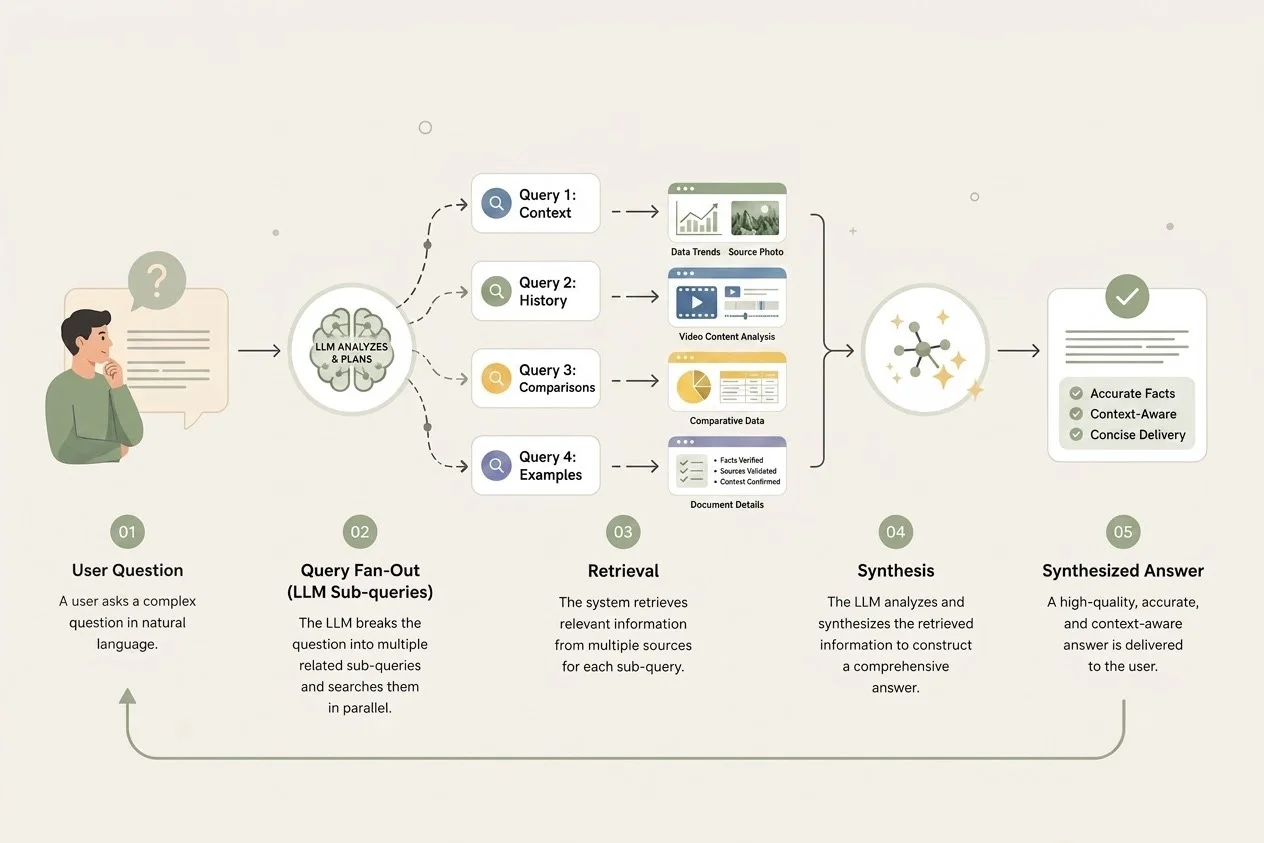
Query fan-out simply describes the multiple queries an LLM searches with in parallel. For example, if someone asks an AI for the best email marketing platform for a small e-commerce business, the AI might search "best email marketing platforms 2026," "email marketing e-commerce features," and "email marketing pricing small business" simultaneously.
To win this game, you need content that ranks for these shorter sub-queries too. Map the prompts your buyers actually use. This goes beyond keywords; consider full conversational sentences across category queries, comparison queries, and problem queries.
At Noqqto, we started manually reverse-engineering these prompts. You can see what ChatGPT searches for by using your browser's network tab or reviewing citation links. Once you find the exact string the LLM uses to retrieve data, you can build dedicated content sections that match that string perfectly.
The Technical Blindspot: Crawlability and Schema
Before anything else, AI systems need to be able to read your pages. No matter how good the content is, weak technical foundations will make it fail. Technical SEO in 2026 ensures your site can be effectively accessed, interpreted, and trusted by crawlers and AI agents, including the emerging wave of agentic experiences now browsing the web on users' behalf.
The Cloudflare Catastrophe and Bot Blocking
Many sites block AI crawlers without realizing it. Cloudflare recently changed its default configuration for many tiers to block AI bots. If you use Cloudflare, your AI bot traffic may have been shut off automatically. Check your server logs for the "ChatGPT-User" user agent to see if AI bots are visiting your site. Avoid client-side rendering for important content: AI crawlers don't browse like humans, and they can only read the HTML your server returns. If your content loads via JavaScript after the page renders, AI bots simply can't see it.
The Schema Imperative and Entity-Centric Content
Implementing structured data is the single most impactful action this year, since LLMs rely on it even more than traditional search engines do. AI systems are machines; they crave structured, easily parseable data. Your CMS largely determines how well your team can execute these strategies, which is why we run this checklist through our web development team on every project:
- Audit structured data coverage to ensure no errors in rich results
- Deploy Organization and WebSite schema sitewide to establish entity authority
- Use entity-appropriate schemas (Article, FAQPage, Product, Service, Event) on every relevant content type
- Add sameAs references connecting your entity to authoritative sources like Wikipedia, Wikidata, or LinkedIn

Core Web Vitals, SXO, and Conversion
SXO requires flawless execution on the design side. Focus on Core Web Vitals: loading speed (Largest Contentful Paint), interaction (Interaction to Next Paint), and visual stability (Cumulative Layout Shift). Getting AI citations only matters if the traffic that does land on your site actually converts, which is why our search experience optimization work runs in tandem with dedicated conversion rate optimization so a faster, cleaner site also closes more business.
Engineering Deep E-E-A-T, Information Gain, and Non-Commodity Content
Let's talk about the acronym everyone loves to throw around. E-E-A-T stands for Experience, Expertise, Authoritativeness, and Trustworthiness. In the old days, we thought we could demonstrate authority by slapping a generic writer bio at the bottom of a page.
Modern generative retrieval engines see right through that. They use a concept called information gain. If your article contains the same sequence of points as the top five results already indexed, your information gain score is zero. To a machine learning model, your page is completely redundant.
The Shift to First-Person, Non-Commodity Content
We instituted a strict editorial rule: every piece of content must contain non-commodity content, meaning genuine, non-commoditized firsthand evidence rather than generic overview paragraphs. AI systems pull facts and weave them into answers. To shape those answers and earn citations, content needs to be easy to read, easy to verify, and rich in context.

Google explicitly contrasts commodity content with non-commodity content. "7 Tips for First-Time Homebuyers" is commodity knowledge anyone could write. "Why We Waived the Inspection and Saved Money: A Look Inside the Sewer Line" is a unique, experienced perspective. You need the latter, and building that kind of authority off-site through consistent brand mentions is exactly what our social media marketing team works on alongside content production.
The Princeton GEO Research Validation
Research out of Princeton University on Generative Engine Optimization identified specific tactics that move the needle. The study found "Cite Sources" and "Statistics Addition" were the top-performing optimization methods, improving AI visibility by 30% to 40% on core impression metrics. By adding hard statistics, citing reputable sources, and using definitive language, you drastically increase your odds of an LLM picking up your content over a competitor's fluff piece.
Case Study: Breaking the In-House Lead Volume Bottleneck
Let's look at the numbers. I want to share a real-world case study where we put these exact GEO and SXO frameworks to the test on a massive scale.
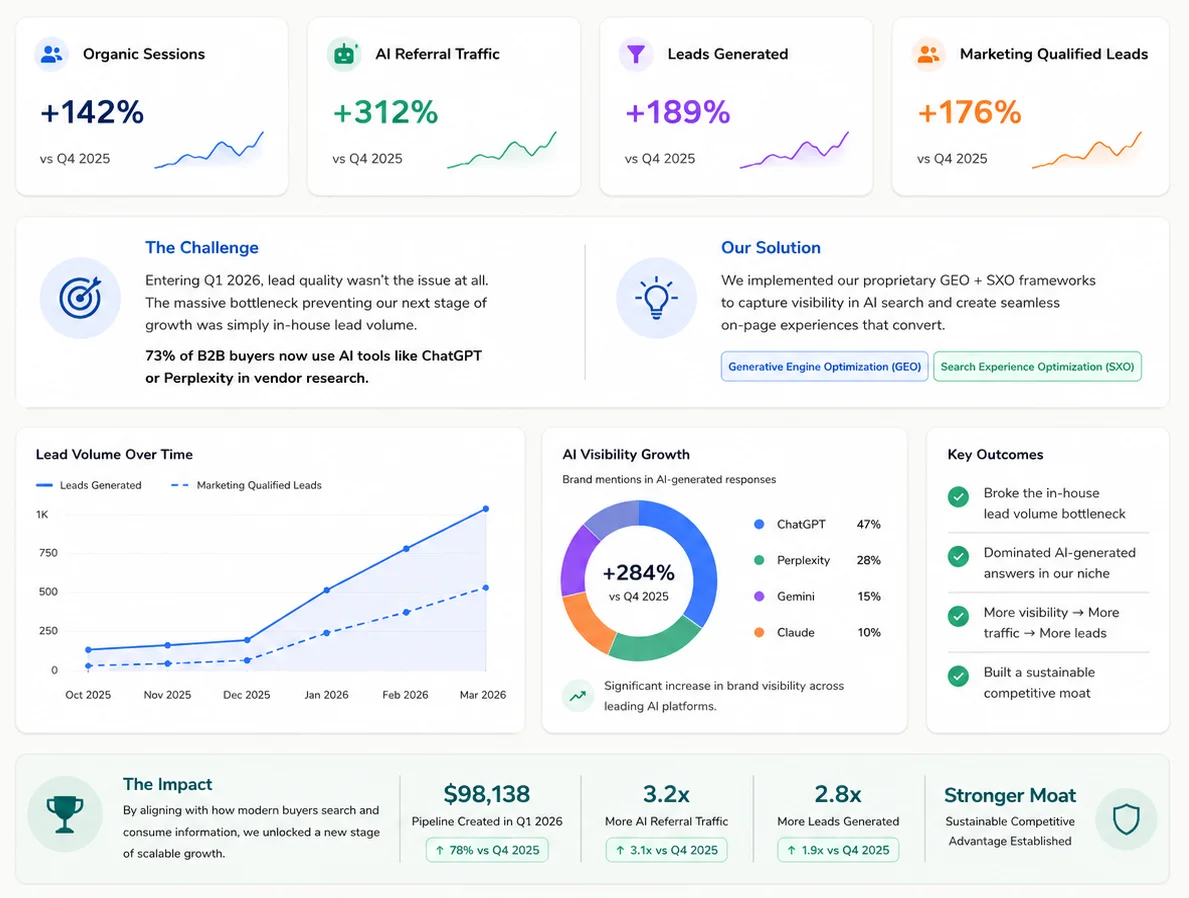
Entering Q1 2026, we were reviewing our own pipeline. Lead quality wasn't the issue at all. The massive bottleneck preventing our next stage of growth was simply in-house lead volume. Users were getting their answers on the SERP and bouncing before they ever hit our funnels. With 73% of B2B buyers using AI tools like ChatGPT or Perplexity in vendor research, we had to adapt fast.
The Overhaul Strategy

We executed a deep structural reconstruction across our own web properties, focused on machine readability and high information gain:
- Semantic restructuring: we mapped our entity identity clearly and shifted content architecture toward at least one pillar page of 2,000+ words per core topic cluster, avoiding fragmented, thin content
- Answer-first formatting: every section leads with a direct, complete answer in the first 40 to 60 words, using inverted pyramid style
- Technical SXO overhaul: we flattened the frontend architecture, cut heavy JavaScript bloat, and made sure our site passed Core Web Vitals all green (LCP under 2.5 seconds, CLS under 0.1, INP under 200 milliseconds)
- Multimodal optimization: we added transcripts to embedded videos and used ImageObject and VideoObject schema heavily
The Results
The results were spectacular. Within 90 days of deploying the new structure, our inclusion rate inside AI search overviews climbed massively. By feeding the bots exactly what they wanted, our brand citations skyrocketed, completely solving our lead volume issue. Because we aligned with the machines and modernized our structural approach, we closed out March 2026 with historic numbers for our entire team.
Structuring for Synthesis: The New Content Rules
If you want to stay visible as generative search systems grow, you need to systematically update your site architecture. Generative engines aren't reading through leagues of lead-up before getting to the point. They're delivering summarized, synthesized information.

Here's the exact optimization workflow we use across all our active agency projects.
Rule 1: Lead With the Answer (The 30% Rule)
Research shows 44.2% of all LLM citations come from the first 30% of a piece of text. Your opening section carries disproportionate weight. Structure pages so accurate, plain-language answers appear near the top, directly after a heading.
Rule 2: Use Clear, Question-Aligned Headings
AI models parse heading structures to comprehend document semantics instantly. Every heading block should stand alone as a complete, useful answer to a specific question. If an LLM extracts just that one section, it should make complete sense on its own.
Rule 3: Use Native Data Modules
Incorporate tables where comparative data exists. Use numbered lists for sequential processes and bullet lists for features or benefits. AI engines love structured HTML lists because they're computationally cheap to parse and format into an AI Overview.
Rule 4: Maintain Content Freshness
Search models heavily penalize outdated information. Pages not updated quarterly are significantly more likely to lose AI citations. Set a content review schedule with visible revision dates to send freshness signals.
Frequently Asked Questions
Q: Is SEO still relevant for AI search?
Yes, absolutely. SEO builds the foundation that AEO and GEO depend on; without technical health, crawlability, and indexation, generative engines have nothing authoritative to cite. Reference rate, rather than click-through rate, is simply becoming the newer metric layered on top of classic rankings.
Q: What is Google AI Overviews optimization, exactly?
It's the practice of structuring content, schema, and site technical health specifically so Google's AI Overviews feature can extract, synthesize, and cite your page. It overlaps heavily with traditional SEO but leans much more on structured data, concise answer formatting, and verifiable statistics.
Q: How is generative engine optimization (GEO) different from AEO?
GEO focuses on brand and entity citation across generative platforms like ChatGPT and Perplexity, while AEO focuses on structuring content so answer engines and featured snippets can extract direct answers. They work together and are best treated as one connected strategy.
Q: What does Google query fan-out mean for content strategy?
It means a single user question triggers several parallel sub-searches behind the scenes. Content strategy needs to address these sub-queries directly, using natural, conversational phrasing rather than a single head keyword.
Q: What is non-commodity content and why does it matter for AI citations?
Non-commodity content is original, experience-based material that only your brand could produce, as opposed to generic advice available everywhere. AI systems favor it because it raises information gain and gives them a genuine reason to cite you over a competitor.
Q: Are agentic experiences going to change SEO again?
Yes. As AI browser agents start completing tasks and purchases on behalf of users, sites will need machine-readable structure, clear schema, and fast, reliable technical performance so agents can act on their content confidently, extending the same principles behind GEO and SXO today.
Final Thoughts: The New Era of Organic Authority
Making the jump from legacy keyword optimization to modern conversational synthesis models can feel daunting at first. But it's an incredible opportunity for digital marketers, SEO specialists, and business owners fully committed to real quality.
This shift is forcing our industry to move away from superficial optimization tricks and return to what digital marketing was always meant to be: creating genuine speed, sharing real expertise, and delivering undeniable value to the end user. If you're still relying on thin content, slow load times, and keyword stuffing, the AI search shift will simply filter you out of the conversation.
Once you stop fighting the shift and start optimizing your site architecture for how modern retrieval engines actually process information, you'll see a massive difference in your organic performance. Your brand citations will grow, your engagement metrics will improve, and you'll build a resilient digital presence ready for whatever comes next.
Let's keep the conversation going. Drop your thoughts, technical questions, or your own recent optimization experiences in the comments below. And remember, if you need a dedicated team to audit your current setup and prepare your platform for the future of generative search, our full-service team at Noqqto is always here to help you lead the way.