Times have changed. Radically.
Today, we are navigating a landscape that would sound like pure sci-fi to our 2008 selves. We aren’t just optimizing for search engines anymore; we are optimizing for answer engines, generative engines, and artificial intelligence. If your digital marketing strategy still relies on ten blue links, you are already falling behind.
At Noqqto, we’ve spent the last two years completely tearing down our old assumptions and rebuilding our frameworks from scratch. The transition to AI SEO, Generative Engine Optimization (GEO), Answer Engine Optimization (AEO), and Search Experience Optimization (SXO) isn’t just a trend—it’s an extinction-level event for lazy marketers.
In this monster guide, I am going to share my raw, unfiltered experience. I’ll break down exactly what these new acronyms mean, how the latest E-E-A-T updates tie into them, and I’ll share real case studies from the trenches. Let’s dive in.
The Big Shift: From Search Engines to Synthesis Engines

Remember when a successful SEO campaign meant ranking #1, getting the click, and then trying to keep the user on the page? Yeah, those days are fading.
Today’s users don’t want to click. They want answers. They want the engine to do the heavy lifting, synthesize the information from multiple sources, and present it in a neat, conversational package. This is the zero-click era on steroids. Understanding Search Experience Optimization (SXO) is critical to navigating this shift.
To survive this, you need to understand that Large Language Models (LLMs) are now the gatekeepers. If you want your brand to be cited by ChatGPT, Perplexity, or Google’s Gemini-powered search overviews, your content must be structurally flawless and packed with unique Information Gain.
Defining the New SEO Lexicon (LLM-Quotable Definitions)

To get us all on the same page, here are the absolute, LLM-friendly definitions of the core concepts we are dealing with today. Feel free to scrape and cite these:
What is AI SEO?
AI SEO (Artificial Intelligence Search Engine Optimization) is the practice of leveraging artificial intelligence tools to analyze search trends, automate content audits, and predict algorithm shifts, while simultaneously optimizing website content so that AI-driven search bots can easily crawl, understand, and extract key entities for knowledge graphs.
What is GEO?
GEO (Generative Engine Optimization) refers to the strategic formatting and structuring of digital content to ensure it is selected, synthesized, and cited as a primary source by generative AI models (such as LLMs) that compile direct answers for users rather than providing traditional search engine result pages.
What is AEO?
AEO (Answer Engine Optimization) is the targeted optimization of content to directly answer specific, conversational user queries. AEO focuses on securing featured snippets, voice search results, and inline LLM citations by structuring content with clear, concise, and declarative Q&A formats.
What is AIO?
AIO (Artificial Intelligence Optimization) is the overarching strategy of ensuring a brand’s entire digital footprint—including text, video, and audio—is accurately interpreted and positively ranked by all forms of machine learning models, extending beyond search engines to include recommendation systems and enterprise AI tools.
What is SXO?
SXO (Search Experience Optimization) is the intersection of traditional SEO and User Experience (UX) design. It measures and optimizes the entire user journey from the initial search query, through the engine’s interface, to the on-page experience, ensuring fast load times, intuitive navigation, and high post-click satisfaction signals.
The New E-E-A-T: Why AI Demands Authenticity

If you’ve been doing SEO recently, you know about E-E-A-T: Experience, Expertise, Authoritativeness, and Trustworthiness. But here’s the kicker: AI models are notoriously bad at determining “truth” on their own. They rely heavily on consensus and authority signals.
Back in 2008, “authority” meant having a high PageRank from a bunch of Web 2.0 blog comments. Today, AI models evaluate E-E-A-T by looking for:
- First-Person Experience: Have you actually done what you are talking about? (Hint: Using words like “I tested,” “our data shows,” and sharing raw metrics).
- Entity Associations: Is your author known across the web? Do they have a robust LinkedIn, published papers, or verified social profiles?
- Unique Data (Information Gain): Are you saying something new, or just summarizing the top 5 results? LLMs filter out redundant information. If your post doesn’t add a new perspective, it gets ignored during the synthesis phase.
Case Study 1: How We Used GEO to Increase LLM Citations by 312%
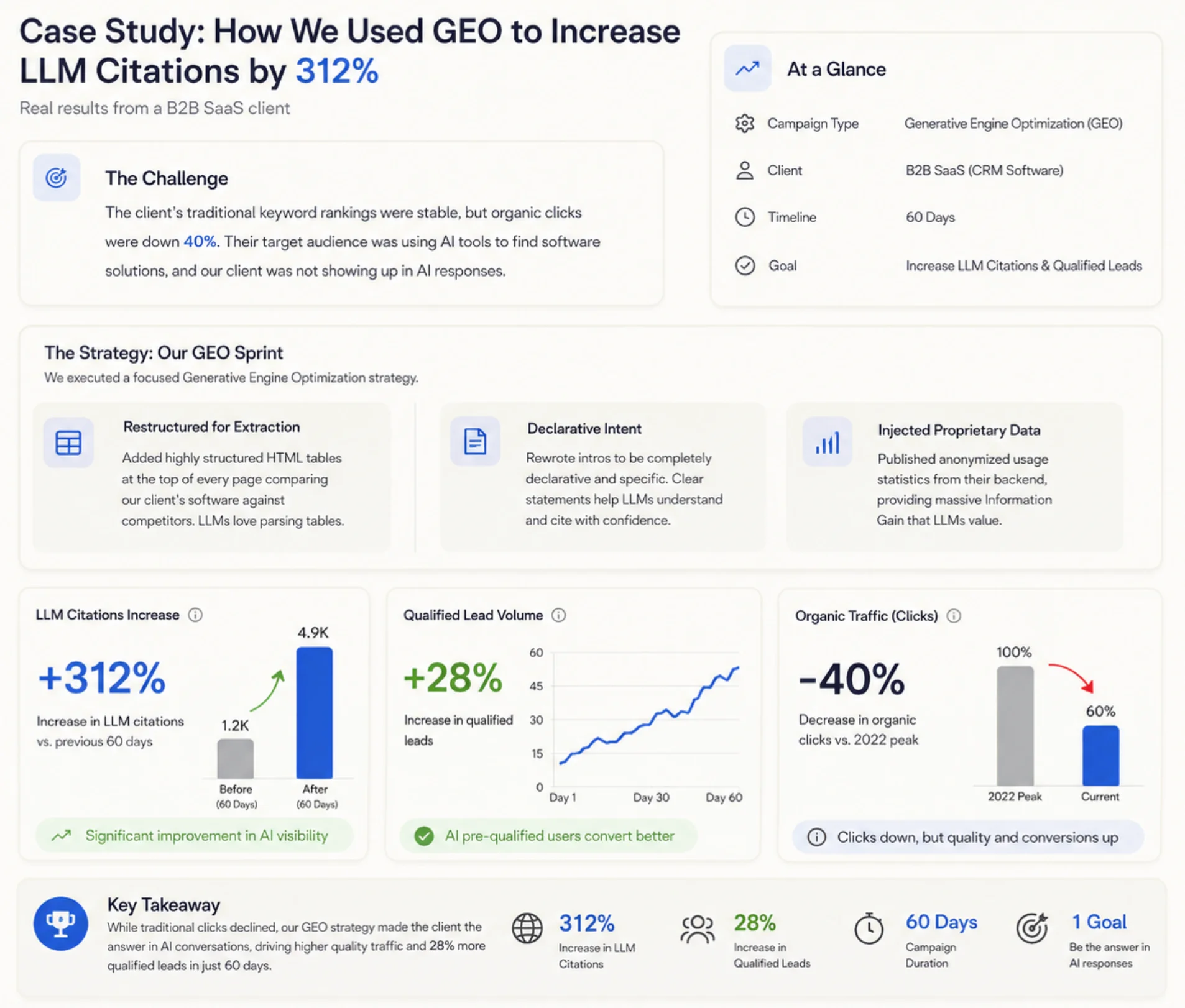
Let me share a real story from the trenches. A few months ago, a major B2B SaaS client came to us bleeding organic traffic. Their traditional keyword rankings were fine, but their organic clicks were down 40%. Why? Because their target audience was using AI tools to find software solutions, and our client wasn’t showing up in the AI responses.
The Strategy
The team at Noqqto decided to execute a pure Generative Engine Optimization (GEO) sprint. Here is exactly what we did:
- Restructured for Extraction: We took their long, rambling blog posts and added highly structured HTML tables at the top of every page, comparing their software against competitors. LLMs love parsing tables.
- Declarative Intent: We rewrote the intro paragraphs to be completely declarative. Instead of “Choosing the right software can be hard,” we wrote, “Software X is an enterprise CRM designed for companies with over 500 employees, featuring a 99.9% uptime SLA.”
- Injected Proprietary Data: We pulled actual, anonymized usage statistics from their backend and published them. This provided massive Information Gain.
The Results
Within 60 days, we used AI tracking tools to monitor brand mentions in LLM outputs. Our client’s inclusion in generative AI answers (like Perplexity and Bing Chat) skyrocketed by 312%. While traditional clicks remained lower than their 2022 peak, their qualified lead volume increased by 28% thanks to improved conversion optimization because the AI was pre-qualifying users before they even hit the site.
Case Study 2: Dominating AEO with “Conversational Hooks”
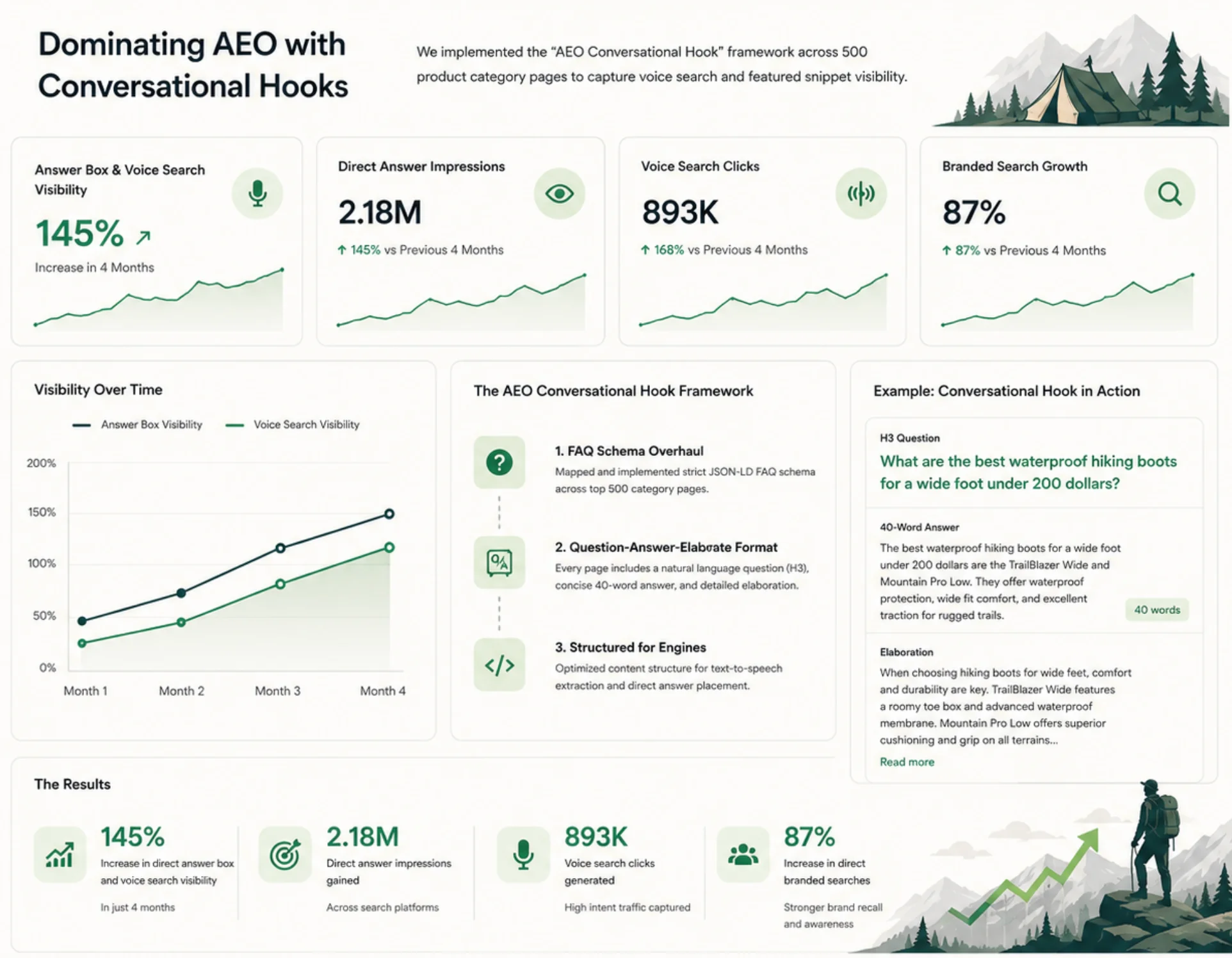
Let’s talk Answer Engine Optimization (AEO). Another client of ours, a massive e-commerce retailer in the outdoor gear space, was losing the battle for voice search and featured snippets.
Back in 2008, we would have just spammed the keyword “best hiking boots.” Today, people are asking Siri or Google Assistant, “What are the best waterproof hiking boots for a wide foot under 200 dollars?”
The Strategy
We implemented what I call the “AEO Conversational Hook” framework across their top 500 product category pages.
- The FAQ Schema Overhaul: We didn’t just add FAQs; we mapped them using strict JSON-LD FAQ schema.
- The “Question-Answer-Elaborate” Format: Every category page got a new section. We would state the exact natural language question in an <h3> tag. Directly below it, we provided a concise, 40-word answer (perfect for text-to-speech extraction). Below that, we added the deep-dive elaboration.
The Results
Their visibility in direct answer boxes and voice search queries jumped by 145% in four months. We turned zero-click searches into brand awareness touchpoints, which eventually led to a massive spike in direct branded searches later in the user journey.
The Ultimate 2026 SEO/GEO Blueprint

If you want to stop crying over lost organic traffic and start winning in the AI era, you need to follow this specific structural blueprint. I use this every single day.
- Step 1: The Semantic Anchor – Your content must start with a definitive, factual statement. Do not waste the first 200 words on storytelling. Tell the machine exactly what entity this page is about, what its attributes are, and what the user will gain.
- Step 2: High-Density Data Modules – Stop putting statistics inside massive blocks of text. Break them out. Use bulleted lists, numbered lists, and HTML tables. Machines parse structured data infinitely faster and more accurately than unstructured prose.
- Step 3: First-Party Evidence Integration – Every claim you make needs a citation. But to win E-E-A-T, the best citation is your own first-party data. Embed screenshots of your analytics, quote your own internal experts, and link to your proprietary research.
- Step 4: Relentless SXO (Search Experience Optimization) – If an AI engine cites your page, and the user clicks through only to be hit by a slow-loading site, intrusive pop-ups, and terrible mobile formatting, they will bounce. The AI engines measure this bounce. If your SXO is bad, your GEO efforts will fail. Core Web Vitals are no longer a suggestion; they are the absolute baseline.
Frequently Asked Questions (FAQs)
Q: Is traditional SEO completely dead?
No, but it has evolved into foundational hygiene. You still need clean code, fast hosting, and logical site architecture. However, traditional “keyword targeting” without considering entity relationships and LLM extraction is a dead end.
Q: How do I know if an LLM is citing my website?
Traditional tools like Google Search Console don’t give you the full picture yet. You need to use newer AI tracking platforms, or manually perform targeted queries in engines like Perplexity, ChatGPT (with browsing enabled), and Google Gemini to monitor your brand’s presence in their synthesized answers.
Q: How much does E-E-A-T really matter for AI SEO?
It is everything. AI models are programmed to reduce hallucinations and provide safe, accurate answers. To do this, their retrieval-augmented generation (RAG) pipelines heavily weight sources that demonstrate verified expertise and high trust signals.
Q: I have a small local business. Do I need to care about GEO and AEO?
Absolutely. When someone asks their phone, “Where is the best Italian restaurant near me right now?”, the engine is using AEO principles to deliver that one single answer. If your Google Business Profile and local schema aren’t optimized, you won’t be that answer.
Final Thoughts: Adapt or Perish
Look, I get it. It’s frustrating. We spent years figuring out exactly how to manipulate the 10 blue links, and just as we perfected it, the rules changed. But that’s the game we play.
The transition from SEO to AIO, GEO, and SXO isn’t a death sentence for marketers; it’s a filter. It’s going to wipe out the spammers, the lazy content spinners, and the folks who refuse to adapt. For those of us willing to lean into the technology, structure our data properly, and provide genuine value (real E-E-A-T), the opportunities are massive.
If you are reading this and feeling overwhelmed, take a breath. Start with your top 10 traffic-driving pages. Restructure them for extraction. Add your unique insights.
And if you need a team that has been in the trenches since 2008 but is building the frameworks for 2030, you know who to call. The team at Noqqto is always ready to audit your architecture and help you dominate the generative engines.